LED vs Halogen vs Xenon Headlights: 2026 Distributor Comparison
As the global automotive lighting aftermarket continues to shift toward energy efficiency, longer service life, and improved lighting performance, auto parts distributors face an important inventory decision. Choosing between traditional halogen bulbs, HID (Xenon), and modern LED headlights requires more than comparing brightness or price. Buyers also need to consider beam performance, vehicle compatibility, regulations, customer demand, and long-term replacement potential.
This comprehensive guide compares LED, Halogen, and Xenon headlights to help distributors and wholesalers make better purchasing decisions and build a product portfolio that matches their target market in 2026.
1. The Bottom Line: Quick Recommendations by Scenario
For distributors looking for a quick strategic overview, here is the practical conclusion for each technology in 2026:
- LED Headlights: The strongest growth opportunity for 2026 inventory, particularly in premium aftermarket, upgrade, and performance-oriented segments where buyers value efficiency, long service life, and modern styling.
- Halogen Headlights: Maintain standard inventory for budget-conscious replacement markets and older vehicles where original-equipment replacement remains important, particularly in price-sensitive markets.
- Xenon (HID) Headlights: Maintain focused inventory for replacement applications, especially older vehicles originally equipped with HID systems and customers who require direct replacement compatibility.
The right inventory strategy therefore does not mean replacing every halogen or Xenon product with LED. Instead, distributors should increase LED exposure while maintaining the legacy technologies required by their customer base and vehicle parc.
2. Brightness, Lifespan, and Power Consumption Comparison
Data-driven procurement is crucial, but technical specifications should always be compared using the same measurement conditions. Lumen claims can vary significantly between manufacturers depending on whether they refer to raw LED output, measured bulb output, or a pair of bulbs.
The table below provides general aftermarket reference ranges rather than universal specifications.
| Specification | Halogen | Xenon (HID) | LED |
|---|---|---|---|
| Typical Luminous Flux* | 1,000–1,500 lm | 2,800–3,500 lm | 4,000–12,000+ claimed lm |
| Typical Lifespan | 450–1,000 hours | 2,000–3,000 hours | 30,000–50,000+ hours claimed |
| Typical Power Consumption | 55–65W | 35–55W | 15–45W |
| Warm-up Time | Near-instant | Several seconds | Near-instant |
| Energy Efficiency | Low | Medium | Generally high |
| Wholesale Margin Potential | Volume dependent | Application dependent | Potentially higher in premium segments |
*Actual output varies by bulb design, test method, optical system, vehicle housing, and manufacturer specifications. Lumen ratings should not be treated as a direct measurement of road illumination.
Why This Matters for Distributors
LED products generally offer advantages in:
- Lower electrical power consumption
- Longer expected service life
- Compact packaging
- Fast start-up
- Flexible product design
However, a higher lumen specification alone does not guarantee better road performance. Distributors should evaluate beam pattern, cutoff quality, thermal management, LED chip positioning, and vehicle compatibility before selecting products for their inventory.
3. Beam Pattern and Cut-off Line
Brightness means little without proper light distribution. One of the most important factors in headlight selection is how the light source interacts with the vehicle’s reflector or projector housing.
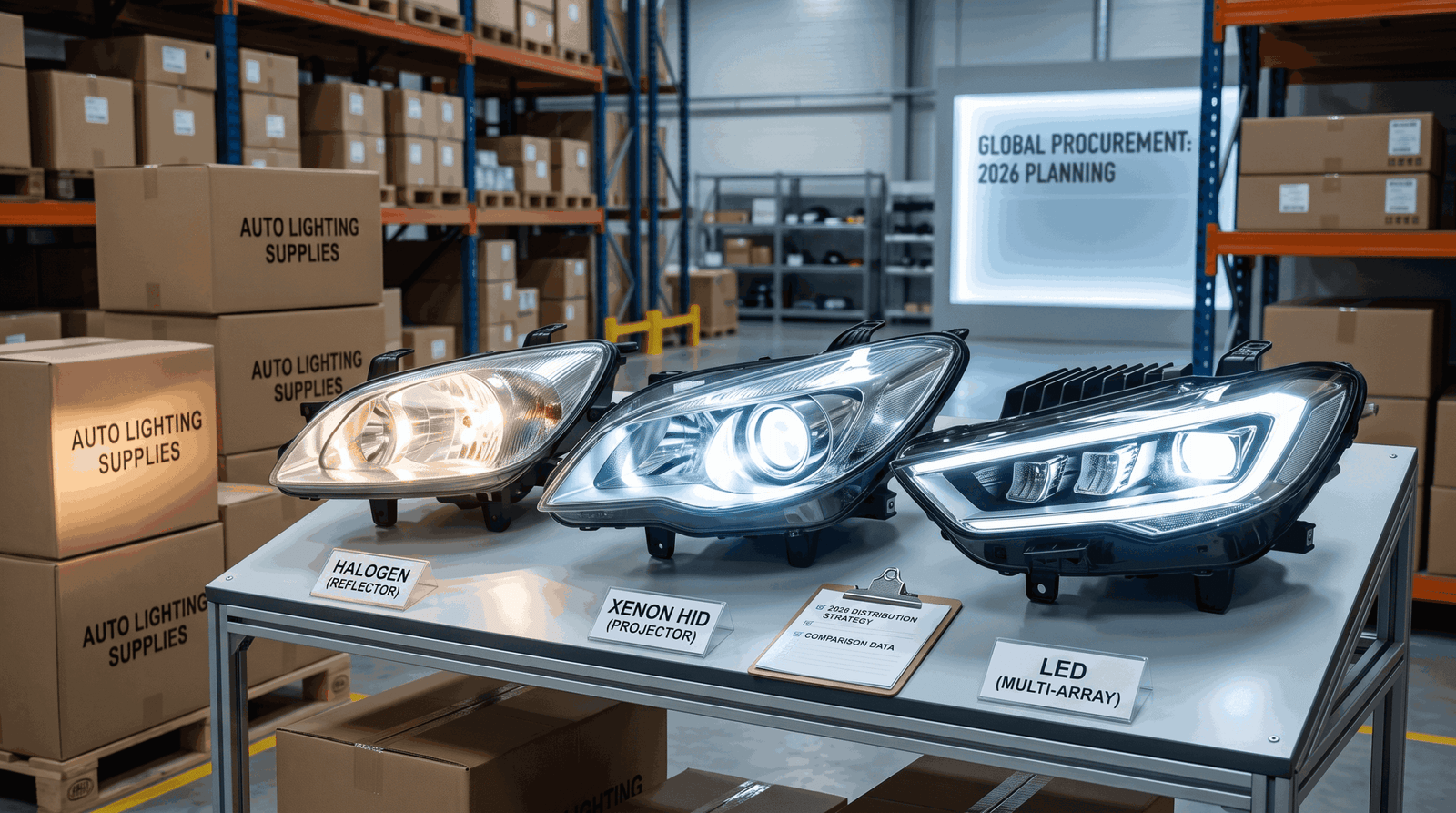
- Halogen: The filament emits light in multiple directions, while the vehicle’s reflector or projector optics shape the light into the required beam pattern.
- Xenon (HID): HID systems use an arc-based light source and are typically designed around dedicated optical systems, particularly projector assemblies, to control beam distribution and reduce glare.
- LED: LED chips produce highly directional light from a compact source. Quality retrofit bulbs are designed to position the light-emitting area as closely as possible to the original halogen filament position, helping reproduce the intended beam pattern and cutoff.
Distributors must match the bulb to the vehicle’s housing type. A mismatch can result in scattered light, poor illumination, excessive glare, or failed inspections where applicable.
For a deeper dive into housing compatibility, read our comprehensive guide on <a href=”/projector-vs-reflector-headlights/”>projector vs reflector headlights</a>.
Why Beam Pattern Matters More Than Headline Lumens
A well-designed LED bulb with moderate stated lumen output can provide better usable illumination than a poorly designed high-lumen bulb.
When evaluating LED headlight suppliers, buyers should therefore check:
- LED chip positioning
- Focal point accuracy
- Cutoff sharpness
- Hotspot location
- Beam width
- Thermal stability
These factors are especially important for distributors selling retrofit products for existing halogen housings.
4. Color Temperature (CCT) and Driving Experience
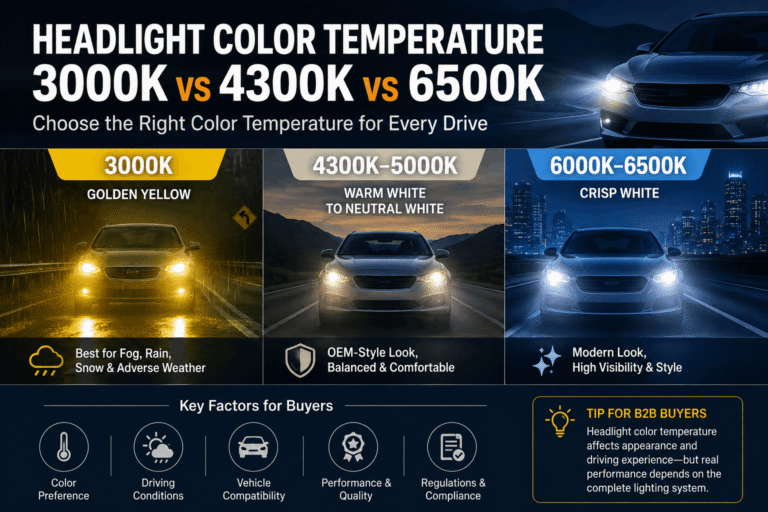
Color temperature influences the perceived appearance of the light and can affect visual contrast and driver preference. However, actual visibility also depends on beam performance, weather conditions, road surfaces, optics, and vehicle design.
Different color temperatures can therefore serve different customer requirements.
| Technology | Typical CCT Range | Driving Experience & Visibility |
|---|---|---|
| Halogen | Around 3000K–3500K | Warm yellow appearance; familiar OEM-style lighting and generally useful in poor-weather conditions |
| Xenon (HID) | Around 4300K–6000K | From warm white to cool white; 4300K is commonly associated with balanced OEM-style HID lighting |
| LED | Broad aftermarket range, commonly 3000K–6500K | Flexible appearance and application options; 5500K–6500K is common for cool-white aftermarket products |
For example:
- 3000K: Warm yellow light, often selected for fog and adverse-weather applications
- 4300K: Balanced white with a warmer appearance
- 5000K–5500K: Neutral white appearance
- 6000K–6500K: Cooler white appearance commonly preferred for styling-oriented aftermarket products
Distributors should avoid treating higher CCT as automatically better visibility. Extremely cool light can have different performance characteristics in rain, fog, and other adverse conditions.
To understand how to stock the right color profiles for specific geographic regions and weather conditions, explore our detailed <a href=”/color-temperature-guide/”>color temperature (CCT) guide</a>.
5. Compatibility: CANbus and Bulb Bases
Modern vehicles use increasingly sophisticated electrical monitoring systems. Replacing a halogen bulb with an LED or HID system changes the electrical load and can sometimes trigger dashboard warnings, flickering, or other compatibility issues.
CANbus Systems
Because many LED retrofit bulbs consume less power than traditional halogen bulbs, some vehicle monitoring systems may incorrectly interpret the lower electrical load as a failed bulb.
Depending on the vehicle, LED products may require:
- CANbus-compatible drivers
- External decoders
- Load resistors
- Error-canceling modules
- Vehicle-specific compatibility solutions
Modern LED kits may include built-in or external solutions, but CANbus compatibility is not universal. Distributors should verify compatibility by vehicle model rather than assuming that a product labeled “CANbus” will work with every vehicle.
Learn how to navigate this issue in our <a href=”/canbus-compatibility/”>CANbus compatibility</a> resource.
Bulb Bases
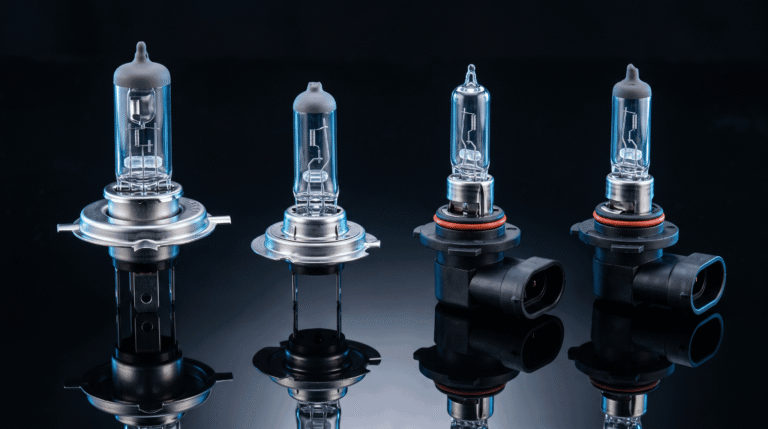
Many halogen and LED retrofit products use the same physical bulb bases, including:
- H1
- H4
- H7
- H11
- 9005
- 9006
This makes LED retrofit products attractive for aftermarket applications.
Xenon systems use different bulb families, such as:
- D1S
- D2S
- D3S
- D4S
These systems may also require compatible ballasts and vehicle-specific components.
Distributors should therefore maintain inventory according to the actual vehicle applications in their target market.
6. Regulations and Certifications
For global distribution, buyers must ensure that their products comply with applicable local road-safety laws, technical standards, and certification requirements.
Selling non-compliant lighting products can create legal, warranty, return, and reputational risks.
| Region | Relevant Standards / Frameworks | LED Retrofit Considerations |
|---|---|---|
| North America | FMVSS 108 and applicable federal/state requirements | Road legality depends on product type, vehicle application, and applicable requirements. Many aftermarket retrofit products may not be approved for unrestricted on-road use. |
| Europe | Applicable UNECE/ECE requirements and national rules | Retrofit legality varies by product, vehicle, country, and approval status. Buyers should verify the specific application rather than assuming all LED retrofits are legal or illegal. |
| Asia-Pacific | Mixed national requirements; some markets adopt or reference UNECE standards | Requirements vary considerably by country. Local inspection and road-use rules should be verified before distribution. |
For example, Japan has strict vehicle inspection requirements, while other Asian markets may have different approaches to aftermarket lighting.
The key point for distributors is simple:
A bulb fitting a vehicle does not automatically mean that the retrofit is road-legal in that market.
Before placing a product into a regional inventory program, buyers should verify:
- Applicable certification requirements
- Vehicle compatibility
- Road-use restrictions
- Testing documentation
- Labeling requirements
- Supplier documentation
To ensure your product lineup meets international compliance requirements, review our breakdown of <a href=”/ece-and-dot-certification/”>ECE and DOT certification</a>.
7. Regional Demand Trends (2026 Outlook)
Consumer demand is shifting globally, but the pace and product mix differ by region. A successful 2026 B2B purchasing strategy should therefore combine broad technology trends with local vehicle populations, customer budgets, and regulatory requirements.
- North America & Europe: LED continues to gain importance in aftermarket upgrades and replacement applications, while halogen and HID remain relevant for existing vehicles. Demand for Xenon replacement products is more concentrated in older HID-equipped vehicles.
- Latin America (LATAM): The market remains highly price-sensitive, creating opportunities for both halogen replacement products and entry-level to mid-range LED solutions. Distributors can benefit from offering different price tiers rather than relying on a single technology.
- Southeast Asia (SEA): LED retrofit demand is strong in many aftermarket segments, with cool-white products commonly popular among styling-oriented customers. Product selection should nevertheless reflect local road conditions, vehicle types, regulations, and customer budgets rather than relying solely on wattage or color temperature.
8. Distributor Selection Guide: Best For…
Use this matrix to align your 2026 procurement strategy with your target customer base.
| Target Audience / Market | Best Technology Choice | Why? |
|---|---|---|
| Premium Auto Shops & Modders | Premium LED Kits | Strong demand for modern styling, fast response, customization, and upgrade performance |
| Mass Market / Budget Retail | Entry-Level LED & Halogen | Broad vehicle coverage, price flexibility, and high replacement demand |
| Heavy-Duty Fleet & Trucking | Commercial LED | Long service life, lower maintenance requirements, vibration resistance, and efficient operation |
| Older HID-Equipped Vehicles | Xenon (HID) D-Series | Direct replacement compatibility for vehicles originally designed around HID systems |
How Distributors Should Build Their Product Mix
Rather than replacing all legacy products with LED, distributors can use a tiered inventory strategy:
Entry Level:
Halogen + affordable LED
Mid Range:
Reliable LED products with CANbus compatibility
Premium:
High-performance LED products with improved thermal management, beam control, and warranty support
Legacy Replacement:
HID/Xenon D-series products for older compatible vehicles
This approach allows distributors to capture both replacement demand and the growing LED upgrade market.
Frequently Asked Questions (FAQ)
A well-designed LED system can outperform many HID systems in usable lighting performance, but higher lumen ratings alone do not guarantee better road illumination. Beam pattern, optics, focal position, thermal management, and vehicle housing compatibility all affect the final result.
Some aftermarket LED products advertise more than 10,000 lumens per pair, but buyers should confirm whether the figure represents claimed or measured output and understand the manufacturer's testing method before comparing products with Xenon.
There is no single global date when halogen headlights will disappear from the aftermarket.
Halogen use is declining in many new-vehicle applications, but millions of existing vehicles still use halogen bulbs. As a result, replacement demand is likely to continue for years, particularly in price-sensitive markets and older vehicle segments.
For distributors, the practical strategy is to gradually increase LED inventory while maintaining sufficient halogen coverage for the vehicles and customers they serve.
It depends entirely on the market, vehicle, lighting assembly, and specific retrofit product.
Some jurisdictions allow certain approved LED retrofit products under defined conditions, while other applications may restrict or prohibit particular retrofit configurations for road use.
Distributors should verify the applicable local regulations, certification requirements, and vehicle compatibility before marketing an LED retrofit as street-legal.
Always check the relevant national requirements rather than assuming that a product legal in one market is automatically legal in another.