CANbus and Error-Free LED Headlights: Why Compatibility Matters
The global transition from traditional halogen bulbs to advanced LED automotive lighting is driven by the demand for superior brightness, longer lifespans, and enhanced driving safety. However, for many distributors, retailers, and end-users, upgrading vehicle headlights isn’t always a simple plug-and-play process. One of the most common and frustrating hurdles in the automotive lighting industry is the sudden appearance of dashboard error codes, flickering lights, or complete bulb shutdowns immediately after installation.
For B2B buyers, CANbus error-free LED headlights are designed to address many of the electrical compatibility challenges that can occur when replacing factory halogen bulbs with LED technology. However, CANbus error-free LED headlights should not be evaluated simply by their marketing label. Their actual performance depends on the LED driver, vehicle lighting control module, bulb-monitoring strategy, PWM behavior, and vehicle-specific testing.
This comprehensive guide explains how CANbus error-free LED headlights work, why error codes happen, how external decoders compare with integrated designs, and how distributors and wholesalers can evaluate CANbus error-free LED headlights before placing a bulk order.
What is CANbus?
To understand how CANbus error-free LED headlights work, you first need to understand the electronic communication network used in many modern vehicles.
Definition: CANbus (Controller Area Network bus) is a robust internal vehicle communication standard designed to allow electronic control units and other devices to communicate with each other without requiring a central host computer. Developed originally by Bosch, it enables real-time data exchange between systems such as the Engine Control Unit (ECU), sensors, body control modules, and other vehicle electronics.
It is important to distinguish the CANbus network from the vehicle’s actual bulb-monitoring function. CANbus itself does not directly measure the current or resistance of an LED bulb. Instead, a vehicle’s lighting control module or body control module (BCM) may monitor the electrical behavior of the lighting circuit and communicate detected faults to other vehicle systems through the vehicle’s communication network.
In older vehicles, electrical systems were relatively simple: a switch closed a circuit, and power flowed to the bulb. In modern vehicles, electronic lighting control systems may perform diagnostic checks to determine whether a lighting circuit is operating as expected.
This distinction is important when selecting CANbus error-free LED headlights. A properly engineered CANbus error-free LED headlights product is intended to work more reliably with vehicle lighting systems that use electronic load monitoring or related diagnostic functions. However, compatibility remains vehicle-dependent and should be verified through testing.
Why Do Dashboard Error Codes Appear? (The Bulb Check Mechanism)
When a driver installs CANbus error-free LED headlights and the dashboard suddenly flashes a “Bulb Out” or “Check Headlight” warning, the bulbs may still be functioning normally. The issue may instead lie in the difference between the electrical characteristics of the original halogen bulb and the replacement LED.
The vehicle’s lighting control system is typically designed around the electrical characteristics of the factory-installed bulb. A standard traditional halogen bulb typically draws between 55W and 65W of power, pulling about 4.5 to 5 amps of current under nominal 12V conditions.
LED technology, by design, is significantly more energy-efficient. A high-quality LED headlight might only draw 15W to 35W of power and approximately 1.5 to 2.5 amps, depending on the product design and operating conditions.
When the vehicle’s lighting control system checks the headlight circuit, the lower electrical load of an LED may differ significantly from the expected load of the original halogen bulb. Depending on the vehicle’s diagnostic strategy, this difference can result in a “Bulb Out” warning, flickering, intermittent operation, or, in some cases, the lighting control module may disable the circuit.
CANbus error-free LED headlights are developed to reduce these compatibility problems by using appropriate driver electronics or other electrical management strategies. However, CANbus error-free LED headlights cannot be considered universally compatible simply because they are marketed as “error-free.” The exact diagnostic method varies by vehicle. Some systems may use cold diagnostic pulses, PWM signals, current monitoring, load detection, or other electronic strategies.
Halogen vs. LED Power Draw Comparison
| Specification | Traditional Halogen Bulb | Standard LED Headlight | CANbus System Reaction |
|---|---|---|---|
| Average Wattage | 55W – 65W | 15W – 35W | Detects anomaly (Draw is too low) |
| Operating Current | ~4.5 Amps | ~1.5 – 2.5 Amps | May trigger “Bulb Out” Error Code |
| Circuit Resistance | High | Low | May fail the vehicle’s expected diagnostic conditions |
Note: The values above are general reference figures. Actual power consumption, current, and electrical characteristics vary according to the bulb, vehicle voltage, LED driver, and operating conditions. CANbus error-free LED headlights should therefore be evaluated using actual vehicle testing rather than these figures alone.
External Decoders vs. Built-in Error-Free Design
To address electrical compatibility problems, the automotive aftermarket has developed two primary solutions: external CANbus decoders and built-in error-free LED designs. These technologies are commonly used in CANbus error-free LED headlights, although their specific electrical designs can vary significantly.
Understanding the difference is crucial for inventory planning and customer experience, especially when purchasing CANbus error-free LED headlights for wholesale distribution.
External CANbus Decoders (Warning Cancellers)
An external decoder is an additional module wired between the vehicle’s factory harness and the new LED bulb. Depending on the design, these modules may contain load resistors, capacitors, electronic circuits, or a combination of components.
A load resistor can increase the electrical load seen by the vehicle’s monitoring circuit, helping some vehicles recognize the aftermarket LED as an acceptable load. However, resistors convert electrical energy into heat and can therefore become very hot during operation. The capacitor or other electronic circuitry may help manage electrical pulses or reduce certain types of flickering, depending on the decoder design.
External decoders can be effective in specific vehicle applications, but they do not guarantee universal compatibility. Their effectiveness depends on the vehicle’s lighting control strategy and the electrical characteristics of the LED product.
For some applications, CANbus error-free LED headlights may still require an external decoder. For others, CANbus error-free LED headlights with an integrated driver can eliminate the need for additional components.
Built-in Error-Free Design
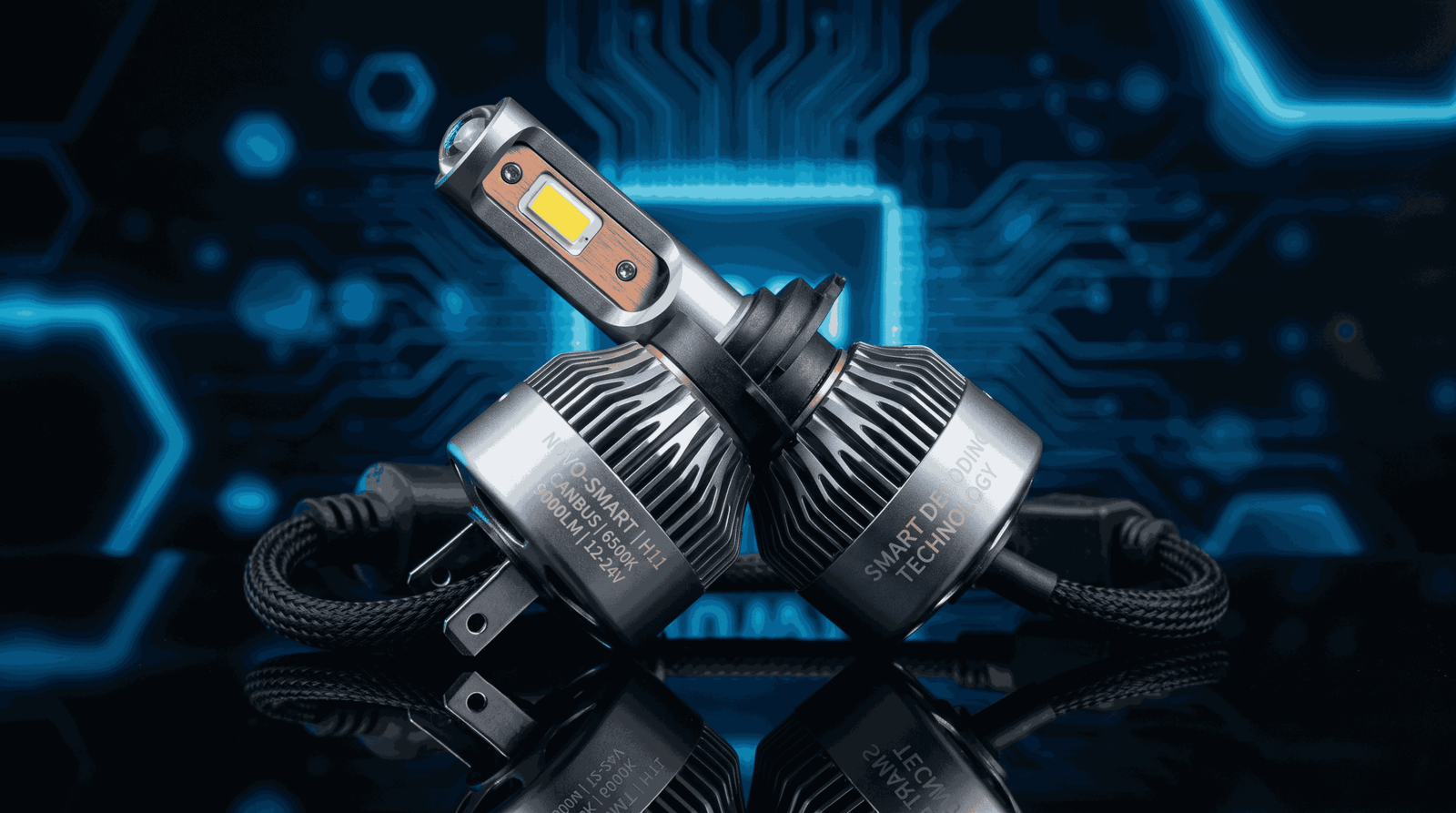
The industry standard has shifted toward intelligent integration. Premium CANbus error-free LED headlights may feature a built-in IC (Integrated Circuit) driver. This driver can manage functions such as current regulation, voltage management, PWM signal handling, thermal protection, and other electrical characteristics designed to improve vehicle compatibility.
An integrated driver can reduce the need for bulky external components and may simplify installation. This is one reason CANbus error-free LED headlights are attractive for distributors, wholesalers, and automotive lighting retailers.
However, the presence of a built-in IC does not automatically guarantee compatibility with every vehicle. The actual performance of CANbus error-free LED headlights depends on the complete driver design and vehicle-specific testing.
Comparison: Decoders vs. Built-in Integration
| Feature | External CANbus Decoder | Built-in Error-Free LED |
|---|---|---|
| Installation | Bulky, requires extra wiring space | More compact, with compatibility functions integrated into the bulb |
| Heat Generation | High (external resistors can get very hot) | Managed within the integrated driver design |
| System Reliability | Depends on wiring, component quality, and installation | Depends on driver design and vehicle-specific compatibility testing |
| Best Used For | Applications requiring additional load or signal management | Modern installations, wholesale & fleet upgrades where compatibility has been verified |
For bulk distributors aiming for lower RMA rates, CANbus error-free LED headlights with integrated compatibility functions can be a practical long-term strategy. However, buyers should evaluate product testing, vehicle application data, thermal performance, and technical support before selecting CANbus error-free LED headlights for wholesale inventory.
Understanding EMC and CISPR 25 Standards
Compatibility extends beyond dashboard warnings; it also involves electromagnetic compatibility. Poorly designed LED drivers can generate electromagnetic interference (EMI) that may affect the vehicle’s electronic environment or radio reception.
Have you ever installed an LED bulb only to hear static on your FM radio or experience electronic interference? This can be related to EMI generated by the LED driver. High-quality CANbus error-free LED headlights should therefore be designed and tested with appropriate EMC requirements in mind.
CISPR 25 is an important automotive standard used to evaluate radio disturbance characteristics from components and systems. Proper EMC testing can help demonstrate that an LED driver has been evaluated for electromagnetic emissions under defined test conditions.
However, CISPR 25 compliance should not be treated as proof of CANbus compatibility. EMC performance and vehicle-specific lighting compatibility are related but separate evaluation areas. When sourcing CANbus error-free LED headlights, buyers should consider both EMC performance and actual compatibility testing.
Causes of Flickering and Hyper-Flashing
Aside from error codes, flickering is another common compatibility issue. One possible cause is Pulse Width Modulation (PWM).
To save energy or control lights such as Daytime Running Lights (DRL), many vehicles rapidly switch the electrical signal on and off using PWM. A halogen bulb’s filament has thermal inertia, so this pulsing may not be visible to the human eye. LEDs, however, respond much faster to changes in the electrical signal.
If the driver in CANbus error-free LED headlights is not designed to handle the vehicle’s PWM signal correctly, it may result in visible flickering, unstable operation, or inconsistent brightness. This is primarily a driver and vehicle-control compatibility issue and should not automatically be classified as a CANbus decoding problem.
Similarly, some vehicles monitor the electrical load of turn-signal bulbs and may interpret the lower LED load as a fault, resulting in “hyper-flashing” or a warning message. Modern vehicles may use electronic control modules rather than traditional thermal flashers, so the exact mechanism varies by vehicle.
A suitable LED driver or compatibility module may help manage these electrical characteristics. For this reason, CANbus error-free LED headlights should be tested on representative vehicles rather than evaluated only by their advertised specifications.
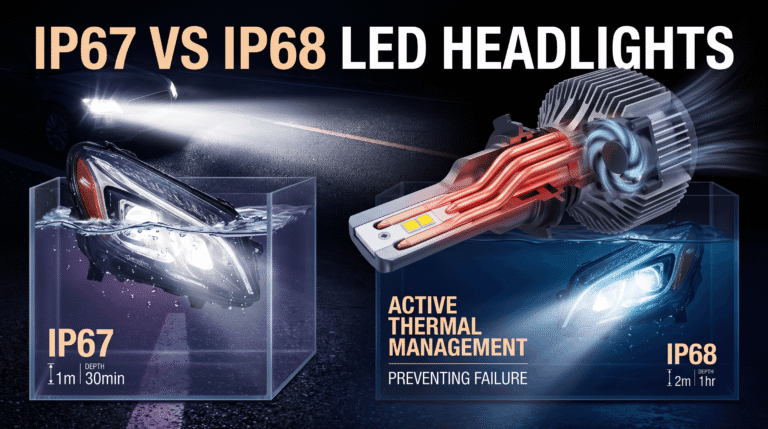
Furthermore, stable electronics require a stable physical environment. An intelligent driver can only perform reliably if it is protected from the elements. Ensuring CANbus error-free LED headlights feature appropriate IP67 protection, where genuinely tested and applicable to the product design, can help protect the electronic components from moisture and dust.
However, IP67 protection is an environmental protection specification and does not by itself guarantee CANbus compatibility.
How to Verify Compatibility Before Ordering
For B2B buyers, wholesalers, and retail chains, ordering a container of incompatible LED headlights is a costly mistake. To protect your brand reputation and reduce post-sale technical support issues, you should verify CANbus error-free LED headlights during the sourcing phase.
When evaluating CANbus error-free LED headlights, buyers should request documented vehicle compatibility information rather than relying only on generic claims such as “error-free” or “CANbus compatible.”
Checklist for Wholesale Buyers:
- Request the IC Specs
Ask your supplier whether the CANbus error-free LED headlights utilize a built-in intelligent IC driver. Request information about operating voltage, driver architecture, PWM handling, thermal protection, and compatibility functions.
- Review Vehicle Compatibility Lists
Reputable manufacturers should be able to provide vehicle-specific testing information. Ask for specific vehicle brands, models, and model years that have been tested. This is more useful than simply asking whether CANbus error-free LED headlights are “universal.”
- Verify Quality Control
Consistency is key. Inquire about the factory QC inspection protocols. Ask whether the CANbus error-free LED headlights undergo burn-in tests, electrical testing, thermal testing, and vehicle compatibility testing before packaging.
- Sample and Test
Always request a sample batch of CANbus error-free LED headlights to test locally on known sensitive vehicles in your target market before committing to a bulk order.
- Verify PWM Compatibility
Ask whether the LED driver has been tested with PWM-controlled lighting systems and whether flickering or unstable operation has been observed during testing.
- Check EMC Performance
Request available EMC test reports or certification documents, including relevant CISPR 25 testing where applicable. Remember that EMC testing should be evaluated separately from CANbus compatibility.
- Confirm Voltage Compatibility
Check whether the product is designed for 12V passenger vehicles, 24V commercial vehicles, or a defined wide input-voltage range. A wide voltage range does not automatically mean universal vehicle compatibility.
- Evaluate RMA and Technical Support
Ask the supplier how compatibility-related complaints involving CANbus error-free LED headlights are handled and whether the manufacturer can provide application support, replacement solutions, or additional compatibility data.
Frequently Asked Questions (FAQ)
A properly designed and correctly installed CANbus decoder used with CANbus error-free LED headlights should operate within appropriate electrical conditions and should not damage the ECU or lighting control module. However, product quality, component ratings, installation method, and vehicle architecture all matter.
External load resistors deserve particular attention because they convert electrical energy into heat. Depending on the resistor value and operating conditions, they can become extremely hot. If a load resistor is installed incorrectly or mounted near plastic components, wiring, or other heat-sensitive materials, it may create a safety or reliability problem.
For this reason, B2B buyers should evaluate the complete decoder design and the electrical design of CANbus error-free LED headlights, including heat dissipation, wiring, component ratings, and installation instructions.
Not always. While standard passenger cars operate on a nominal 12V system, heavy-duty trucks and commercial vehicles commonly use a nominal 24V system.
Some CANbus error-free LED headlights use wide-voltage drivers, such as 9V-32V, allowing the same product platform to operate across both 12V and 24V electrical systems. However, voltage compatibility does not guarantee compatibility with every vehicle's lighting control system.
A product may support the correct voltage but still experience issues related to PWM signals, bulb monitoring, connector configuration, polarity, DRL operation, or vehicle-specific electronic control.
Therefore, buyers should verify both voltage compatibility and vehicle application compatibility before installing CANbus error-free LED headlights.
Installing a strict 12V-only LED bulb into a 24V vehicle system can overload the driver and cause product failure.
Ensure Compatibility with CANbus Error-Free LED Headlights
In the competitive automotive aftermarket, selling a bright LED isn't enough—it must integrate appropriately with the vehicle's electrical and lighting control systems. CANbus error-free LED headlights should therefore be evaluated across several dimensions, including electrical load characteristics, LED driver design, PWM compatibility, EMC performance, thermal management, voltage range, and vehicle-specific testing.
For distributors, wholesalers, and fleet suppliers, selecting reliable CANbus error-free LED headlights can help reduce installation problems, customer complaints, and compatibility-related returns. However, no single IC, decoder, or specification can guarantee compatibility with every vehicle.
The safest sourcing strategy is to request product samples, vehicle compatibility data, driver specifications, EMC documentation, QC information, and technical support before placing a large order.
Don't risk your brand's reputation on incompatible, untested technology. Contact our engineering team today to request a comprehensive compatibility test report and product samples of our latest CANbus error-free LED headlights. We can help you evaluate suitable products for your target vehicle applications and wholesale requirements.