IP67 vs IP68 LED Headlights: Key Differences
Upgrading to IP67 vs IP68 LED headlights is often discussed when buyers evaluate waterproof protection, durability, and long-term automotive lighting reliability. However, choosing between IP67 and IP68 should involve more than simply comparing two numbers.
A bulb marketed with a 30,000-hour lifespan may still experience flickering, reduced brightness, driver problems, or moisture-related issues if its thermal management or sealing system is poorly designed.
For distributors, wholesalers, automotive repair businesses, and lighting brands, understanding IP67 vs IP68 LED headlights requires looking at the complete product design. IP protection, thermal management, sealing quality, driver reliability, component selection, and production quality control all contribute to real-world performance.
This guide explains the differences between IP67 and IP68 LED headlights, how thermal design affects reliability, how manufacturers test water and dust resistance, and what B2B buyers should verify before placing a bulk order.
What Is an IP Rating? Ingress Protection Explained
When comparing IP67 vs IP68 LED headlights, the first step is understanding what the IP rating actually measures.
The IP (Ingress Protection) rating system is an internationally recognized classification defined by IEC 60529. It describes the degree of protection provided by an enclosure against the ingress of solid particles and water.
For automotive LED headlights, the IP rating indicates how effectively the product enclosure protects internal components from dust and water under specified test conditions.
However, an IP rating does not by itself guarantee resistance to heat, vibration, chemicals, thermal cycling, electrical stress, or long-term automotive operating conditions.
The IP rating consists of two numbers:
| IP Digit | Protection Type | Meaning in Automotive Context |
|---|---|---|
| First Digit (6) | Solid Particle Protection | 6 = Dust Tight. The enclosure provides complete protection against dust ingress under the applicable test conditions. |
| Second Digit (7 or 8) | Liquid Ingress Protection | 7 = Temporary Immersion. Protection against temporary immersion under specified test conditions, commonly up to 1 meter for up to 30 minutes. 8 = Continuous Immersion. Protection against continuous immersion under conditions specified by the manufacturer and applicable testing requirements. |
When evaluating IP67 vs IP68 LED headlights, buyers should verify the exact product configuration, applicable test conditions, and supporting test documentation instead of relying only on the IP number printed on the product packaging.
IP67 vs IP68 LED Headlights: What Is the Difference?
The primary difference between IP67 vs IP68 LED headlights is the level and duration of water exposure covered by the applicable test conditions.
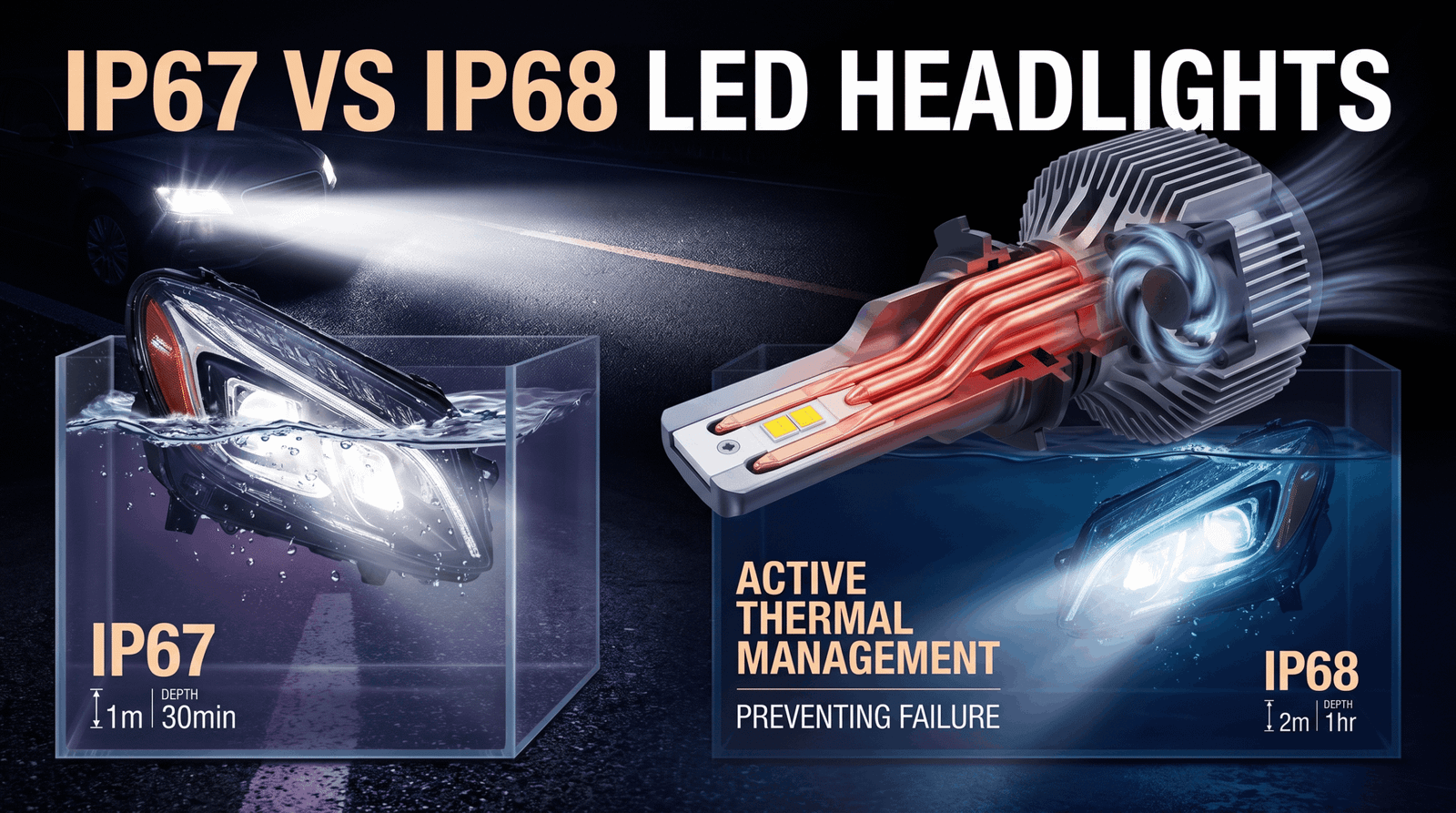
An IP67-rated enclosure is designed to withstand temporary immersion under specified conditions, commonly up to 1 meter of water for up to 30 minutes.
An IP68-rated enclosure is designed for continuous immersion under conditions specified by the manufacturer and applicable testing requirements. The exact immersion depth and duration for IP68 can vary, so buyers should review the manufacturer’s test documentation instead of assuming that every IP68 product has identical performance.
This distinction is important for automotive lighting because actual installation environments vary considerably.
| Driving Scenario | IP67 LED Headlights | IP68 LED Headlights | Consideration for Vehicles |
|---|---|---|---|
| Heavy Rain / Storms | Strong protection when properly designed and installed | Strong protection when properly designed and installed | Both can provide substantial protection against normal severe-weather exposure. |
| High-Pressure Car Washes | Resistance depends on product design and installation | Resistance depends on product design and installation | Sealing, installation, and actual test conditions matter. |
| Off-Road Water Exposure | Suitable where exposure remains within tested conditions | May provide additional protection where prolonged or deeper immersion is expected | Select the rating according to the actual operating environment. |
| Under-Hood Humidity | Helps limit moisture ingress when properly sealed | Helps limit moisture ingress when properly sealed | Neither rating eliminates condensation caused by temperature and pressure changes inside the enclosure. |
For most normal driving applications, IP67 LED headlights provide substantial protection against rain, splashes, and temporary water immersion.
IP68 LED headlights may be relevant when deeper or more prolonged water exposure is expected. However, the appropriate rating should always be evaluated together with the product’s installation environment, enclosure design, and supporting test documentation.
The key lesson when comparing IP67 vs IP68 LED headlights is that a higher IP number does not automatically mean a better product for every vehicle application.
Why IP67 vs IP68 LED Headlights Can Still Experience Failures
If an IP67 or IP68 LED headlight has been tested for water resistance, why can moisture-related problems still occur?
The answer often involves the interaction between temperature, pressure, sealing, and thermal management.
High-power LED chips generate significant heat in a relatively small area. If that heat is not transferred away efficiently, LED junction temperature and driver temperature can increase.
During operation and after shutdown, temperature and pressure inside an enclosure can also change. If the sealing system or pressure-equalization design is inadequate, humid air may enter the enclosure. Subsequent cooling can cause moisture to condense on internal surfaces.
This means that IP67 vs IP68 LED headlights should not be evaluated only by their water-ingress rating.
The primary factors that can contribute to premature LED headlight failure include:
- Thermal Degradation: If the LED junction temperature remains above the intended operating range, component degradation can accelerate, potentially reducing light output and shortening service life.
- Seal Degradation: Low-quality sealing materials, improper assembly, mechanical stress, or prolonged exposure to elevated temperatures can reduce sealing performance and increase the risk of moisture ingress.
- Driver Overheating: The LED driver must operate within its intended thermal range. Excessive driver temperature can contribute to flickering, output instability, component degradation, or protective shutdown depending on the driver design.
For B2B buyers comparing IP67 vs IP68 LED headlights, these factors are important because an IP rating represents a specific ingress-protection performance level, not a complete long-term durability guarantee.
Thermal Design for IP67 vs IP68 LED Headlights
Thermal management is one of the most important considerations when evaluating IP67 vs IP68 LED headlights.
Because LED chips convert electrical energy into both light and heat, an effective thermal path is required to transfer heat away from the LED chip and dissipate it into the surrounding environment.
Reliable automotive LED headlights may combine different thermal-management technologies depending on the required power level, installation space, operating environment, and product architecture.
| Cooling Technology | Type | Mechanism & Benefits | Reliability Impact |
|---|---|---|---|
| Aviation Aluminum Body | Passive | Aluminum is commonly used as a heat-sink material because of its combination of thermal conductivity, low weight, machinability, and corrosion resistance. External fins or surface area help dissipate heat into the surrounding air. | Can contribute to stable thermal performance when correctly sized for the LED load. |
| Copper PCBs & Heat Pipes | Passive | Copper-based thermal paths can efficiently transfer heat away from the LED mounting area. Heat pipes may also be used in some designs to move heat away from high-temperature areas. | Can help reduce LED junction temperature when properly designed and matched to the thermal load. |
| Cooling Fans | Active | Forced airflow increases heat transfer from the heat sink to surrounding air and can help maintain a more stable operating temperature. | Can support thermal stability in higher-power designs when the fan, heat sink, and driver are properly matched. |
When active and passive cooling systems are properly combined, an LED headlight can maintain a more stable operating temperature.
This can help protect the LED, driver, PCB, and sealing components from excessive thermal stress.
However, cooling technology alone does not guarantee a specific service life. Actual durability depends on the complete system design, electrical loading, operating environment, component quality, and manufacturing consistency.
Therefore, when evaluating IP67 vs IP68 LED headlights, B2B buyers should assess both ingress protection and thermal design rather than treating the IP rating as the only reliability indicator.
How to Verify Water and Dust Resistance in Production
Claiming an IP rating is easy; demonstrating consistent performance in production requires appropriate testing and quality-control procedures.
For distributors, wholesalers, automotive repair businesses, and lighting brands, verifying the manufacturer’s testing protocols is an important part of supplier evaluation.
IP testing uses different methods depending on the claimed protection level.
Solid-particle protection tests evaluate resistance to dust or other specified particles, while water-protection tests use different exposure conditions depending on the claimed IP level, including methods such as dripping, spraying, water jets, or temporary immersion.
Reliable manufacturers should not rely on a single IP test alone.
A complete validation program for automotive LED headlights may also include:
- Photometric testing
- Thermal testing
- Electrical testing
- Thermal cycling
- Sealing inspection
- Driver testing
- Vibration testing where applicable
- Production QC inspection
Photometric testing can verify light output and beam performance, while thermal testing can measure operating temperatures under defined conditions.
Thermal cycling can help evaluate how repeated temperature changes affect components, seals, and enclosure performance.
For B2B buyers comparing IP67 vs IP68 LED headlights, the key question is not simply whether a supplier claims “IP67” or “IP68.”
The more important question is whether the manufacturer can provide credible test documentation for the exact production configuration being supplied.
Certifications and Manufacturer Claims for IP67 vs IP68 LED Headlights
Navigating the automotive aftermarket requires careful evaluation of certification and compliance claims.
An IP rating printed on a product box is not sufficient evidence of product reliability without supporting documentation.
When sourcing IP67 vs IP68 LED headlights, buyers should ask manufacturers for relevant EMC test reports, RoHS compliance documentation, and IP test reports applicable to the specific product.
EMC — Electromagnetic Compatibility
EMC testing evaluates whether an LED driver and product design meet applicable electromagnetic-emission and immunity requirements.
For automotive applications, electromagnetic compatibility can be particularly important because LED drivers operate within an electrically complex vehicle environment.
RoHS Compliance
RoHS demonstrates compliance with applicable restrictions on specified hazardous substances.
Buyers should request appropriate compliance documentation rather than treating a simple RoHS logo printed on packaging as sufficient verification.
IP Test Report
An IP test report provides evidence of the tested dust and water protection level under the applicable test conditions.
When comparing IP67 vs IP68 LED headlights, buyers should confirm that the IP documentation corresponds to the actual product model and configuration being purchased.
Generic certificates from another product should not automatically be treated as evidence for the current product.
What B2B Buyers Should Check Before Purchasing IP67 vs IP68 LED Headlights
For distributors and wholesalers, comparing IP67 vs IP68 LED headlights should be part of a broader supplier-verification process.
Before placing a bulk order, consider requesting:
- Product-specific IP test reports
- Thermal test data
- Photometric test results
- EMC test documentation
- RoHS compliance documentation
- Product specifications and electrical parameters
- Driver protection information
- QC inspection procedures
- Production sample testing
- Warranty terms
- Batch consistency records
A reliable supplier should be able to explain how the product achieves its claimed IP rating and how the thermal-management system supports stable operation.
The objective is not simply to find the highest IP number.
The objective is to identify an LED headlight whose sealing, thermal management, electrical design, materials, and production quality are appropriate for the intended vehicle application.
Frequently Asked Questions (FAQ)
Yes. An IP67-rated enclosure is designed to withstand temporary immersion under the specified IP67 test conditions, commonly up to 1 meter of water for up to 30 minutes.
However, this rating should not be interpreted as a guarantee for continuous underwater operation or for every real-world vehicle installation.
For products intended for deeper or prolonged immersion, buyers should review the manufacturer's specific IP68 test conditions.
Not necessarily.
IP68 provides protection against continuous immersion under specified conditions, while IP67 addresses temporary immersion under specified conditions.
The appropriate choice depends on the actual operating environment.
For many conventional automotive applications, the additional immersion capability of IP68 may not provide a practical benefit if the product will not experience prolonged or deep water exposure.
Thermal design, sealing quality, driver reliability, optical performance, and manufacturing consistency should also be considered.
If an LED cooling fan fails or becomes obstructed, the product may lose part of its active cooling capability.
Some LED headlight systems use temperature sensors and driver-control algorithms to monitor operating temperature. Depending on the driver design, excessive temperature may trigger current reduction, protective shutdown, or other thermal-management measures.
However, not every LED headlight includes automatic thermal protection.
B2B buyers should therefore confirm the specific driver's thermal-protection functions with the manufacturer.
Not necessarily.
Fanless designs eliminate a moving component and may simplify the thermal and environmental design, but the absence of a fan does not automatically result in a higher IP rating.
Likewise, a fan-equipped LED headlight may achieve an appropriate level of environmental protection when the complete product is correctly designed and tested.
The choice between active and passive cooling should be based on required light output, thermal load, available installation space, environmental conditions, and overall product design.
Stop guessing with your automotive lighting supply.
Reliable automotive LED headlights require more than a high IP rating. Their real-world performance depends on the interaction between thermal management, sealing, electrical design, component quality, and production consistency.
For B2B automotive lighting sourcing, ask your supplier for relevant thermal test data, IP test reports, QC documentation, and applicable certification or compliance documents.
This allows you to evaluate the actual reliability of an LED headlight rather than relying solely on marketing specifications.
Contact our engineering team to request available thermal analysis reports, factory QC inspection information, and certification documents for our latest LED headlight ranges.