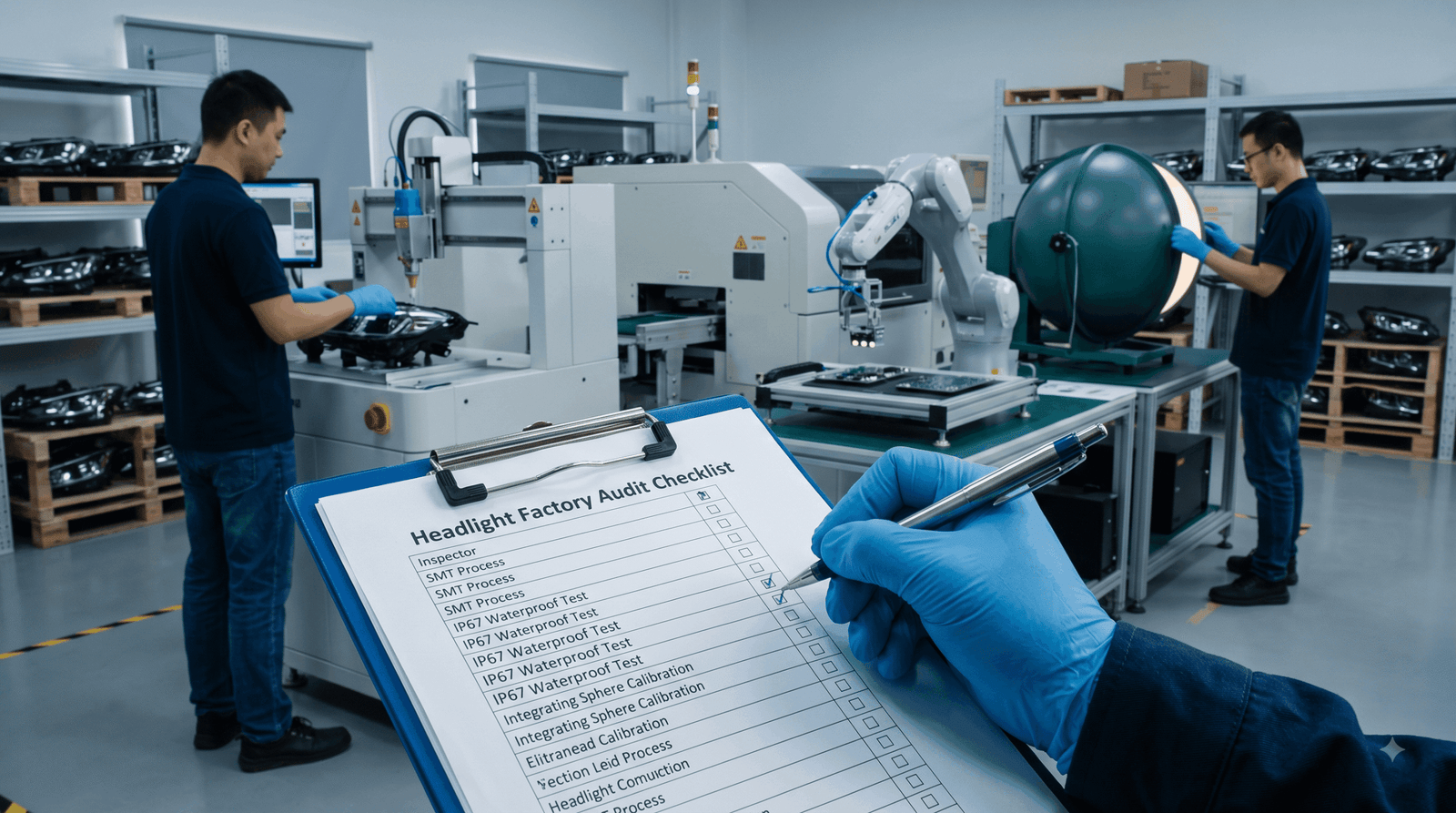
Partner Factory Audit Checklist: 30+ Points to Verify Before You Order
Whether you are sourcing automotive LED headlights for an aftermarket brand, distributor network, or OEM partnership, relying only on Alibaba profiles, product photos, or supplier brochures can create significant risks.
A professional factory audit is one of the most effective ways to verify a supplier’s actual manufacturing capabilities, quality systems, and long-term reliability before committing to bulk orders.
In this comprehensive guide, we provide a 30+ point partner factory audit checklist, specifically designed for automotive lighting manufacturers and international buyers.
Pre-Audit Preparation: Essential Documents to Request
Before arranging a factory visit or third-party inspection, request and review key supplier documents first.
This preliminary screening helps buyers understand the supplier’s background, verify basic compliance information, and identify potential risks before spending time and resources on an audit.
Request the following documents and verify them before your physical or remote audit:
| Document Type | Purpose | Red Flags to Watch Out For |
|---|---|---|
| Business License | Verifies legal company information and registered business activities. | Company information does not match the claimed manufacturing activities or contracting entity. |
| Export Records | Shows experience serving international customers and target markets. | Supplier refuses to provide any reasonable proof of export experience. |
| ISO 9001 Certificate | Indicates an established quality management framework. | Expired certificates or certificates issued by questionable organizations. |
| Automotive Quality Certifications | Helps verify industry-specific management systems when applicable, such as IATF 16949. | Certification scope does not match the products or company being audited. |
| Third-Party Test Reports | Validates product performance claims such as optical output, safety, or environmental testing. | Reports do not identify the manufacturer or cannot be verified. |
| BOM (Bill of Materials) | Provides visibility into key components used in the lighting product. | Component descriptions are too vague or cannot be traced to suppliers. |
Certifications and Compliance Verification
Once the audit begins, certification verification should be one of the first steps.
Do not rely only on certificates displayed on office walls. Review original documents, certification scope, validity dates, and whether the certificate applies to the actual manufacturing entity.
It is important to distinguish between:
- Management system certifications — such as ISO 9001 or IATF 16949, which demonstrate process control capability.
- Product compliance certifications — such as E-Mark, DOT, CE, or RoHS, which relate to specific market or product requirements.
A supplier may have different certifications depending on its customers, products, and target markets.
Audit Checkpoints (Points 1-5)
- Original Certification Documents
Request original or officially issued copies of relevant certificates, including applicable automotive lighting certifications.
- Certification Verification
Cross-check certificate numbers through official databases or certification bodies whenever possible.
- Patent and Intellectual Property Review
Check whether the supplier owns relevant design patents, optical solutions, or cooling system technologies where applicable.
- Environmental Compliance
Review environmental permits and compliance documents, especially if the factory operates processes such as injection molding, coating, or other controlled manufacturing activities.
- Quality Management Documentation
Review quality manuals, defect handling procedures, corrective action processes, and standard operating procedures (SOPs).
Production Line Inspection: Manufacturing, Assembly, and Process Control
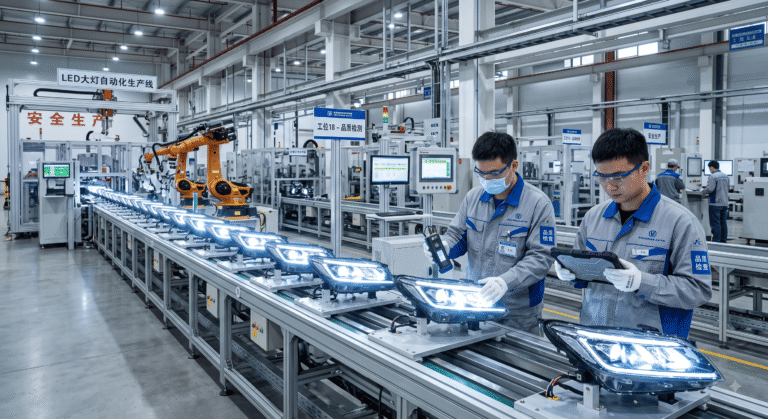
The production area is where buyers verify whether the supplier has the actual manufacturing capability, process control, and quality discipline required for automotive lighting products.
Not every manufacturer performs every process internally. Some factories outsource certain components, such as PCB production or electronic modules, while maintaining control over assembly, testing, engineering, and final quality inspection.
The audit objective is not simply to find specific machines.
The objective is to verify that the supplier has appropriate and controlled manufacturing processes matching the products they provide.
Manufacturing Process Audit Table
| Production Area | Key Audit Points (Points 6-17) | Standard Expectation |
|---|---|---|
| Electronics Manufacturing / SMT (If Applicable) | ESD management, soldering quality, PCB process control, supplier qualification. | Proper electronic process controls, traceability, and quality inspection procedures. |
| Injection Molding | Raw material management, mold maintenance records, tooling control. | Proper mold storage, process monitoring, and consistent lens/housing quality. |
| Assembly Line | SOPs, workstation organization, torque control, adhesive application process. | Standardized assembly procedures and operator training records. |
| Optical Adjustment Process | Beam pattern testing, optical alignment procedures, calibration control. | Stable optical performance and repeatable adjustment standards. |
| Aging Testing | Aging duration, voltage fluctuation testing, failure recording. | Products undergo appropriate reliability testing before shipment. |
| Production Traceability | Batch records, production labels, operator records. | Finished products can be traced back to production information. |
Quality Control (QC) & Testing Equipment InspectionA reliable automotive lighting supplier requires more than production capability.
The factory should demonstrate a structured quality system covering:
- Incoming material inspection
- Production process control
- Finished product testing
- Failure analysis
- Corrective actions
- Product traceability
A supplier does not necessarily need to perform every test internally. However, if testing is outsourced, there should be clear standards, records, and control procedures to maintain consistent quality.
Verify the Presence and Use of Testing Equipment (Points 18-24)
1. Integrating Sphere & Darkroom
Used to measure:
- Light output
- Color temperature
- Beam pattern
- Optical performance
Check whether equipment is properly maintained and calibrated.
2. Thermal Shock Chamber
Used to evaluate performance under temperature changes and environmental stress.
3. Salt Spray Tester
Used to evaluate corrosion resistance of:
- Aluminum housing
- Connectors
- Metal components
4. Vibration Testing Equipment
Used to simulate vehicle operating conditions and verify mechanical reliability.
5. Waterproof Testing Equipment
Verify applicable IP protection testing requirements, such as IP67/IP68 where required by product specifications.
6. IQC (Incoming Quality Control)
Check whether incoming:
- LEDs
- Drivers
- PCB components
- Electronic parts
are inspected before production.
7. OQC (Outgoing Quality Control)
Verify final inspection procedures before shipment, including:
- Appearance inspection
- Function testing
- Packaging checks
- Sampling procedures
Warehousing, Materials, and Traceability
Poor material management can directly affect product reliability.
Automotive lighting products contain sensitive electronic components, optical parts, and precision assemblies. A professional factory should demonstrate proper storage conditions, inventory control, and traceability systems.
Warehousing Audit Focus (Points 25-28)
| Warehousing Audit Focus | Audit Points | Why It Matters |
|---|---|---|
| Electronic Component Storage | Are LEDs, PCB components, and electronic parts stored under appropriate humidity and ESD controls? | Prevents moisture damage, component degradation, and soldering failures. |
| Material Identification System | Are incoming materials labeled with supplier information, batch numbers, and inspection status? | Ensures production teams use approved materials and enables traceability. |
| Batch Traceability | Can finished headlights be traced back to production batches, raw materials, and inspection records? | Supports warranty analysis, recalls, and continuous improvement. |
| FIFO / Inventory Management | Does the factory use a controlled First-In, First-Out inventory system where applicable? | Reduces aging inventory risks and improves material management efficiency. |
| Finished Goods Storage | Are completed products stored properly before shipment? | Prevents moisture damage, packaging damage, and transportation issues. |
Personnel, R&D Capabilities, and Labor Compliance
A reliable long-term automotive lighting partner requires more than equipment.
The factory should have:
- Experienced engineering personnel
- Stable production management
- Trained operators
- Documented quality responsibilities
- Safe working conditions
Personnel and Capability Audit (Points 29-33)
29. R&D Engineering Team
Evaluate:
- Number of electrical engineers
- Optical engineers
- Mechanical engineers
- Product development experience
- Ability to support customization
For customized automotive lighting projects, engineering capability is often as important as manufacturing capacity.
30. Product Development Process
Verify whether the supplier has a structured process for:
- Product design review
- Prototype development
- Sample approval
- Engineering changes
- Production validation
A mature supplier should be able to explain how a product moves from concept to mass production.
31. Worker Training and Qualification
Check:
- New employee training procedures
- Workstation qualification requirements
- Operator skill records
- Regular refresher training
Automotive products require consistent assembly processes, especially for waterproofing, optical alignment, and electronic connections.
32. Employee Stability and Production Management
Review:
- Worker turnover
- Production supervisor experience
- Shift management
- Production planning methods
High employee turnover may increase the risk of inconsistent production quality.
33. Safety and Labor Compliance
Inspect:
- Fire exits
- Emergency equipment
- Workplace safety procedures
- Ventilation systems
- Legal working conditions
A professional supplier should maintain both product quality and responsible manufacturing practices.
Additional Supplier Management Audit Points (34-36)
To complete a comprehensive factory evaluation, buyers should also review supplier management systems.
34. Supplier Qualification System
Check whether the factory evaluates and manages its own suppliers for:
- LEDs
- PCB components
- Drivers
- Raw materials
- Packaging materials
A factory’s quality depends partly on how effectively it controls its upstream supply chain.
35. Engineering Change Control
Verify whether the supplier has procedures for:
- Component substitutions
- Design modifications
- Process changes
- Customer approval before major changes
Uncontrolled changes can create unexpected product differences between batches.
36. Customer Complaint and Warranty Management
Review:
- Complaint handling procedures
- Root cause analysis
- Corrective action reports
- Warranty tracking systems
A reliable supplier should not only prevent problems but also have a structured response process when issues occur.
On-Site Sampling Plan
A factory audit should not end with a showroom visit.
Product samples should be selected using a controlled process to verify that actual production output matches supplier claims.
Sampling Verification Steps
1. Select Random Production Samples
Avoid accepting only showroom samples prepared by the supplier.
Where possible:
- Select units directly from the production line
- Follow agreed inspection standards
- Use appropriate sample quantities based on order size and inspection requirements
2. Conduct On-Site Functional Tests
Verify actual performance through available testing equipment.
Examples include:
- Optical testing
- Waterproof testing
- Electrical testing
- Appearance inspection
- Assembly quality checks
3. Document and Seal Samples
For important projects:
- Record sample information
- Photograph inspection results
- Label samples
- Maintain approval records
This creates a reference standard for future mass production.
Downloadable Factory Audit Scorecard (PDF)
A structured scoring system helps buyers compare suppliers objectively.
Instead of relying only on impressions during a factory visit, evaluate suppliers across key categories:
| Audit Category | Suggested Weight |
|---|---|
| Manufacturing Capability | 25% |
| Quality Management System | 25% |
| Testing Capability | 20% |
| Engineering & R&D | 15% |
| Supply Chain Management | 10% |
| Communication & Documentation | 5% |
Rate each category from 1-5 based on audit findings.
A supplier with strong production equipment but weak quality systems may not be the best long-term partner.
Conclusion: A Factory Audit Is an Investment in Supply Chain Reliability
Choosing an automotive lighting supplier involves more than comparing prices.
A professional factory audit helps buyers evaluate:
- Real manufacturing capability
- Quality management systems
- Production consistency
- Engineering support
- Long-term cooperation potential
Before placing a large order, verify not only what the supplier says they can do, but also whether their systems can consistently deliver what your customers expect.
A reliable automotive lighting partner should provide the right balance of:
- Manufacturing capability
- Product quality
- Technical support
- Supply-chain stability
- Transparent communication
Frequently Asked Questions (FAQ)
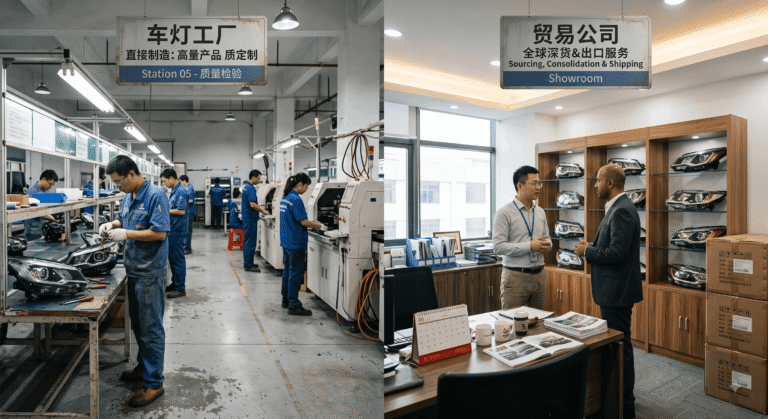
Not necessarily.
A trading company may include a service margin, but its value can extend beyond simply reselling factory products.
A capable trading or sourcing company may provide supplier selection, product sourcing, quality-control coordination, export documentation, logistics management, and communication support.
For smaller buyers or companies purchasing multiple product categories, these services can reduce the internal workload required to manage Chinese suppliers.
A reputable trading company can establish quality-control procedures and coordinate inspections at partner factories, but buyers should not rely on the supplier type alone as a guarantee of product quality.
Quality should be controlled through:
- Clear product specifications
- Approved samples
- Inspection standards
- Pre-shipment inspections
- Certification verification
- Packaging requirements
- Traceability procedures
- Contractual quality requirements
The key question is therefore not simply “Is this a factory or trading company?”
It is:
“Does this supplier have a reliable and verifiable system for delivering the quality, consistency, and service that my business requires?”