OEM vs ODM vs Private Label Headlights: Which Sourcing Model Fits Your Market?
Introduction
In the highly competitive automotive lighting aftermarket, choosing the right sourcing model can directly impact your profit margins, product differentiation, and long-term brand growth.
For distributors, wholesalers, and automotive lighting brands, headlight sourcing is not simply about finding the lowest-cost supplier. The manufacturing model you choose determines how much control you have over product design, exclusivity, customization, investment requirements, and speed to market.
Should you invest in a completely customized OEM headlight project with dedicated tooling, or should you start with a private label solution to quickly test your market?
The answer depends on your business stage, sales volume, target customers, and long-term brand strategy.
In this comprehensive guide, we compare OEM, ODM, and Private Label headlights by analyzing customization level, tooling investment, lead time, intellectual property considerations, and business advantages. This will help you select the right sourcing approach for your automotive lighting business.
1. Defining the Differences: OEM, ODM, Private Label Headlights Explained
Before working with a headlight manufacturer, it is important to understand the differences between these three sourcing models.
Many buyers confuse OEM, ODM, and Private Label because the boundaries can vary depending on the supplier, product category, and agreement terms. A clear understanding helps avoid misunderstandings regarding customization scope, tooling ownership, and product exclusivity.
Private Label Headlights (White Label)
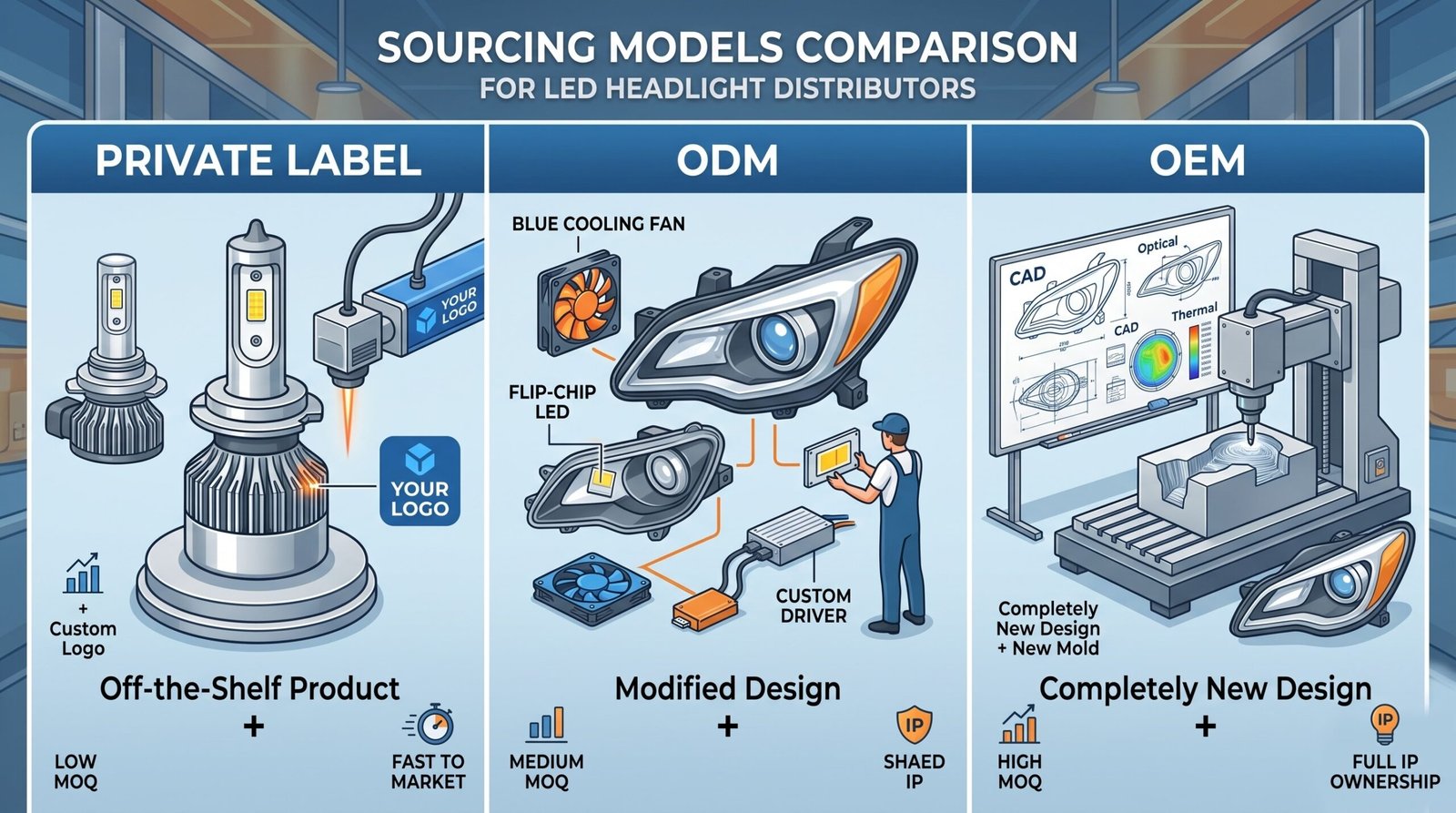
Private Label is the fastest and lowest-risk way to launch your own automotive lighting brand.
Under this model, you select an existing product from a manufacturer’s catalog and customize the branding elements, such as:
- Logo printing or laser engraving
- Retail packaging
- User manuals
- Product labeling
In most cases, the factory owns the original product design, production tooling, and core technology unless the buyer separately invests in exclusive tooling or product modifications.
Application in Headlights:
For example, you may select an existing H7 LED headlight bulb from a manufacturer’s product range.
The factory can customize:
- Your brand logo on the aluminum heat sink
- Customized retail packaging
- Product labels
- Marketing materials
This allows distributors to enter the market quickly without large R&D investment.
ODM Headlights (Original Design Manufacturer)
ODM represents a middle ground between standard products and fully customized OEM development.
With ODM sourcing, the factory provides an existing platform or design, while the buyer requests modifications to improve performance, appearance, or market differentiation.
Typical ODM modifications include:
- LED chip upgrades
- Cooling system improvements
- Driver customization
- Housing design changes
- Connector or CANbus compatibility improvements
Application in Headlights:
A distributor may select an existing LED headlight platform but request:
- Upgrade from standard CSP chips to premium LED chips
- Improve thermal management
- Modify the cooling fan design
- Adjust the external driver for better vehicle compatibility
ODM allows brands to create differentiated products without paying the full cost of developing a completely new product.
Depending on the agreement, buyers may obtain exclusive rights to specific modifications, designs, or regional distribution.
OEM Headlights (Original Equipment Manufacturer)
OEM represents the highest level of customization and investment.
In a custom OEM headlight project, the buyer typically provides detailed product requirements, including:
- Optical performance requirements
- Mechanical specifications
- Thermal management targets
- Electrical requirements
- Vehicle compatibility standards
The manufacturer then develops the product according to these specifications.
Unlike standard private label products, OEM projects usually involve:
- New tooling development
- Engineering samples
- Product testing
- Production validation
Application in Headlights:
For example, a brand may develop a custom LED headlight bulb featuring:
- A unique cooling structure
- A proprietary beam pattern design
- Customized housing components
- Dedicated tooling
The buyer may obtain exclusive rights to the customized design, tooling, or specifications depending on the contract terms with the manufacturer.
2. Cost and Lead Time Comparison Matrix
Moving from Private Label to ODM and OEM requires increasing levels of investment, engineering involvement, and development time.
Understanding these differences is essential when planning your headlight sourcing strategy.
If you are preparing a customized lighting project, you should also evaluate MOQ requirements, payment terms, and supplier capability before committing to development costs.
Sourcing Model Comparison
| Metric | Private Label Headlights | ODM Headlights | OEM Headlights |
|---|---|---|---|
| Customization Level | Branding and packaging customization | Product modifications based on existing designs | Full product development based on specifications |
| Upfront Development Cost | Low (mainly packaging and branding) | Medium (modification and engineering costs) | High (tooling, engineering, testing) |
| Typical Tooling Investment | Usually none | Around $500-$5,000 depending on modifications | $5,000-$50,000+ depending on product complexity |
| Typical MOQ | 100-500 sets | 500-2,000+ sets | Depends on tooling and production requirements |
| Time to Market | 7-15 days for existing products | 30-90 days depending on modifications | 3-6 months or longer |
| IP / Exclusivity | Factory-owned design in most cases | May include exclusive modifications | Usually negotiated through tooling and development agreements |
| Competitive Advantage | Brand positioning | Product differentiation | Strongest product barrier |
Important Note About OEM Costs
OEM investment varies significantly depending on the product category.
For example:
- LED bulb customization usually requires lower tooling investment.
- Complete LED headlight assemblies involving plastic injection molds and optical development require much higher investment.
Therefore, buyers should evaluate OEM costs based on product complexity rather than using a fixed industry number.
3. Choosing the Right Model Based on Market Maturity
Your current market position should determine your sourcing strategy.
A common mistake among new brands is investing heavily in OEM development before proving market demand.
A smarter approach is to gradually increase customization as sales volume and market knowledge grow.
The Distributor Growth Roadmap
Phase 1: New Market Entry (Startups & Local Wholesalers)
Best Model:
Private Label Headlights
Strategy:
The priority at this stage is reducing risk and validating market demand.
Instead of investing heavily in product development, focus your resources on:
- Building distribution channels
- Testing customer preferences
- Understanding vehicle compatibility requirements
- Developing brand awareness
For example, test whether your customers prefer:
- 6000K cool white lighting
- 4300K warm white lighting
- Higher brightness output
- Better CANbus compatibility
Private Label allows you to enter the market quickly while keeping initial investment controlled.
Phase 2: Growth and Differentiation (Regional Distributors)
Best Model:
ODM Headlights
Strategy:
Once your brand has established customers, selling the same products as competitors becomes a challenge.
At this stage, ODM helps you create differentiation through:
- Better cooling performance
- Improved reliability
- Vehicle-specific compatibility
- Unique product appearance
Instead of competing only on price, you begin competing through product advantages.
Phase 3: Market Expansion (Established Brands)
Best Model:
OEM Headlights
Strategy:
For brands with stable sales volume and strong distribution networks, OEM development can create a stronger market barrier.
By investing in dedicated tooling and custom specifications, brands can:
- Create unique products
- Control product quality standards
- Reduce direct comparison with competitors
- Build long-term brand assets
However, OEM should be considered only after sufficient market demand has been proven.
4. Advanced Private Label Headlights: Packaging, SKU Protection, and Brand Premium
Choosing Private Label headlights does not mean competing only on price.
Many successful automotive lighting brands start with private label products and build competitive advantages through branding, product positioning, and supplier management.
The key challenge is avoiding becoming another distributor selling the same generic product as everyone else.
Elevating Your Private Label Product
A standard LED headlight bulb can become a premium branded product through better customer experience and market positioning.
Instead of using basic packaging, brands can improve perceived value through:
- Premium retail boxes
- EVA foam protection inserts
- Professional product manuals
- Multilingual instructions
- Better product photography
- Brand-focused packaging design
For example, instead of simply printing a logo on the package, brands can also consider:
- Laser engraving the logo on the aluminum heat sink
- Customizing product labels
- Creating unique retail presentation
These improvements help transform a standard factory product into a recognizable market brand.
SKU Protection and Product Exclusivity
One of the biggest challenges with Private Label headlights is product similarity.
A factory may produce the same platform for multiple customers unless exclusivity arrangements are clearly defined.
To protect your investment, buyers should discuss:
- Product exclusivity
- Regional protection
- Customized product specifications
- Agreement terms with the manufacturer
For example, if you invest in:
- A unique housing modification
- Special packaging
- Exclusive component selection
you should negotiate whether the factory can provide the same configuration to competing distributors in your target market.
A well-structured supplier agreement helps protect your brand positioning while maintaining a healthy manufacturing relationship.
For companies looking to build a profitable automotive lighting brand without immediately investing in full tooling, a strong Private Label headlights strategy can provide a practical balance between speed, cost, and differentiation.
5. Maximizing ROI: Combining Customization with Exclusive Distribution
Customization investment only creates long-term value when it is protected properly.
Whether you choose ODM headlights or OEM headlights, developing unique products requires cooperation between the buyer and manufacturer.
Without clear agreements, your investment in product improvements may create advantages for competitors.
Protecting ODM Investments
For ODM projects, buyers should clearly define:
- Which modifications are exclusive
- Which markets are protected
- How long exclusivity applies
For example:
If you pay for:
- A redesigned cooling system
- A customized driver solution
- A special housing structure
you may negotiate exclusive use of these modifications within your target market.
Protecting OEM Projects
For custom OEM development, agreements should clearly define:
- Tooling ownership
- Design ownership
- Confidentiality obligations
- Manufacturing rights
Common agreements may include:
- NDA (Non-Disclosure Agreement)
- NNN agreements (Non-Disclosure, Non-Use, Non-Circumvention)
- Exclusive manufacturing agreements
The exact protection level depends on the contract structure and applicable legal environment.
A successful headlight sourcing strategy is not only about creating a better product. It is about building a sustainable advantage around product development, supplier cooperation, and market protection.
6. The Supply Chain: How Professional Partners Support OEM and ODM Projects
Managing a customized headlight project internationally can be challenging.
OEM and ODM development involves many technical details, including:
- LED chip selection
- Beam pattern requirements
- Thermal performance
- Electrical compatibility
- Vehicle application testing
- Quality control procedures
Small communication errors can result in:
- Production delays
- Incorrect specifications
- Quality problems
- Additional development costs
Why Many Brands Use OEM/ODM Coordination Services
Experienced distributors often work with professional sourcing partners or trading companies that have:
- Local supplier networks
- Engineering communication capability
- Factory inspection experience
- Quality control systems
- Export documentation knowledge
These partners can help coordinate between overseas buyers and manufacturers.
Their role is especially valuable when projects involve:
- Multiple suppliers
- Custom tooling
- Prototype approval
- Production monitoring
Managing Compliance and Export Requirements
Automotive lighting products may face different regulatory requirements depending on the destination market.
Examples include:
- DOT/SAE requirements in North America
- E-Mark regulations in Europe
- Local vehicle lighting standards in different countries
Before mass production, buyers should confirm that:
- Product specifications match market requirements
- Testing documents are available
- Export documentation is complete
A professional OEM/ODM coordination process helps reduce compliance risks and improves supply chain reliability.
Frequently Asked Questions (FAQ)
A complete OEM headlight development project typically takes around 3 to 6 months, depending on product complexity.
The process may include:
- Product requirement confirmation
- Engineering design
- Prototype development
- Tooling preparation
- Sample testing
- Performance validation
- Mass production approval
Projects involving complete headlight assemblies or complex optical systems may require additional development time.
Yes, but the MOQ depends on the level of customization.
For basic Private Label headlights:
- Existing products with logo customization may require relatively small quantities.
For customized packaging:
- Printing factories may require higher minimum quantities.
For example:
- Product customization may start from hundreds of units.
- Fully customized packaging may require larger packaging orders.
Many brands reduce inventory pressure by ordering packaging materials separately while purchasing products in smaller production batches.
Generally, yes.
ODM usually starts from an existing product platform, which reduces:
- Development time
- Engineering cost
- Tooling investment
OEM requires more customization and therefore requires greater investment.
However, the final cost depends on:
- Product complexity
- Tooling requirements
- Production volume
- Customization level
Yes, but exclusivity depends on negotiation with the manufacturer.
Private Label products usually use existing factory designs.
However, buyers can create stronger differentiation through:
- Exclusive packaging
- Product modifications
- Regional agreements
- Customized specifications