One-Stop Headlight Sourcing: How QC, Consolidation, and Flexible MOQ Help Distributors
For automotive lighting distributors, managing a supply chain is often a juggling act. Sourcing LED, halogen, and HID headlights across different vehicle models can mean dealing with multiple factories, separate quality standards, different production schedules, and multiple shipping arrangements. This fragmented approach can lead to communication delays, inconsistent quality, higher logistics costs, and rigid Minimum Order Quantities (MOQs).
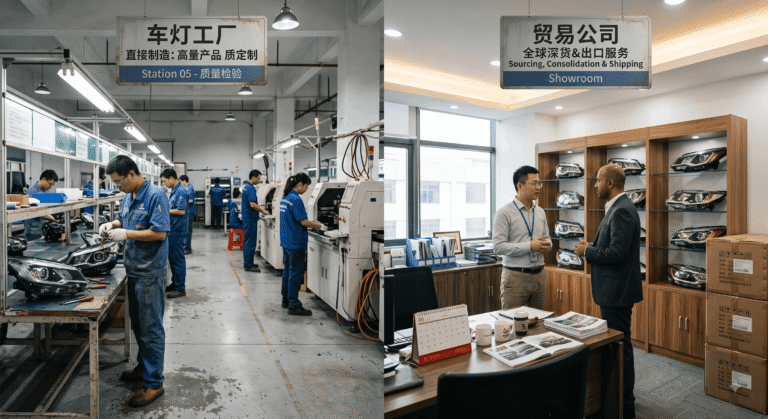
Enter the one-stop headlight sourcing model. Instead of managing every factory independently, distributors can work with a dedicated sourcing partner that coordinates product sourcing, quality control, consolidation, private labeling, and logistics through a single purchasing channel. In this guide, we will explore how one-stop headlight sourcing can simplify procurement and help distributors manage cost, quality, and product variety more efficiently.
What Does a One-Stop Supplier Solve?
The traditional sourcing model can force distributors to act as project managers, coordinating between multiple factories simply to maintain a complete product catalog. Different suppliers may have different communication processes, QC standards, MOQs, packaging requirements, and production schedules.
A one-stop headlight sourcing partner helps eliminate much of this coordination burden by consolidating products and supply-chain services through a single point of contact.
Multi-Factory Comparison vs. One-Stop Sourcing
Managing multiple factories can create hidden operational costs. Here is how a one-stop headlight sourcing model compares with traditional direct-to-factory sourcing:
| Business Aspect | Traditional Multi-Factory Sourcing | One-Stop Sourcing Solution | Impact on Distributors |
|---|---|---|---|
| Communication | Multiple sales contacts and production teams | Single point of contact | Less communication and coordination work |
| SKU Management | Product lines are fragmented across suppliers | Multiple SKUs coordinated through one sourcing partner | Easier product planning and purchasing |
| Payment Management | Separate payments to multiple suppliers | Consolidated purchasing and payment where applicable | Fewer transactions and simpler administration |
| Lead Times | Production schedules vary between factories | Production and availability coordinated through one partner | More predictable replenishment planning |
| Quality Control | Different factories may use different QC procedures | Standardized inspection requirements | More consistent product quality |
| Logistics | Separate shipments from different suppliers | Products can be consolidated before shipment | Better opportunities to optimize freight |
By centralizing purchasing, distributors are not simply buying headlights from another company. They are gaining a more coordinated supply-chain process.
A capable sourcing partner can provide access to a broader range of automotive lighting products—from LED headlight bulbs and conversion kits to halogen bulbs, housings, and other lighting components—without requiring the buyer to independently qualify and manage every supplier.
Quality Control & Pre-Shipment Inspection
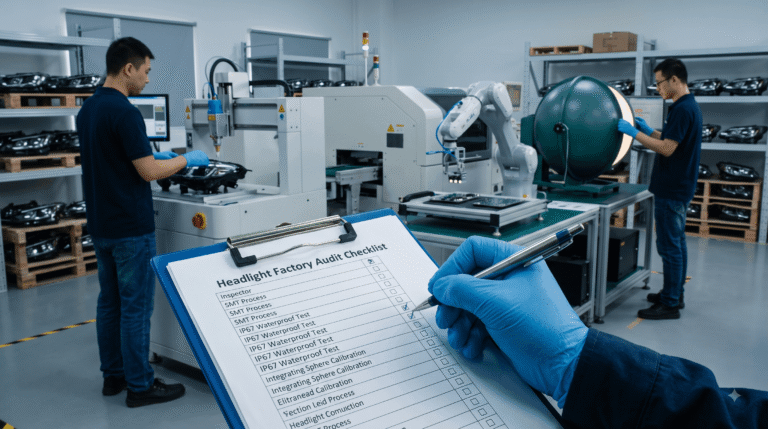
When distributors purchase from multiple factories, quality standards can vary between suppliers and even between product lines. A professional one-stop headlight sourcing partner should establish clear inspection requirements and apply consistent QC procedures across the products being sourced.
This does not replace product certification or regulatory approval. Instead, QC helps verify that the products supplied match the agreed specifications and that required documentation and compliance requirements for the target market have been properly addressed.
Depending on the destination market and product type, buyers may need to consider requirements related to standards or regulations such as DOT, SAE, E-Mark, or other applicable automotive lighting requirements.
A professional sourcing partner can also conduct pre-shipment inspection before goods leave the factory or warehouse. This gives distributors an opportunity to identify quality issues before shipment rather than discovering them after the products arrive.
Standardized QC Checkpoints for Automotive Headlights
| Inspection Stage | Key Focus Areas | Typical Rejection Criteria |
| Visual Inspection | Housing finish, lens clarity, connectors, wire integrity | Scratches, poor sealing, damaged components, exposed wires |
| Performance Testing | Light output, beam pattern, color temperature, electrical performance | Abnormal output, inconsistent beam pattern, incorrect specifications |
| Durability Testing | Waterproofing, thermal management, operating stability | Water ingress, abnormal heat buildup, unstable operation |
| Packaging Check | Box durability, barcode accuracy, labeling, product protection | Crushed boxes, incorrect labels, damaged packaging |
The exact inspection criteria should be agreed upon before production or shipment and should reflect the buyer’s product specifications and target-market requirements.
By identifying quality problems before shipment, distributors can reduce the risk of receiving non-conforming products, protect their brand reputation, and minimize the cost associated with returns or replacement claims.
Container Consolidation & Logistics Integration
One of the challenges faced by distributors purchasing from several factories is the cost and complexity of shipping smaller quantities. When individual suppliers ship separately, buyers may face multiple freight arrangements, documentation requirements, handling charges, and delivery schedules.
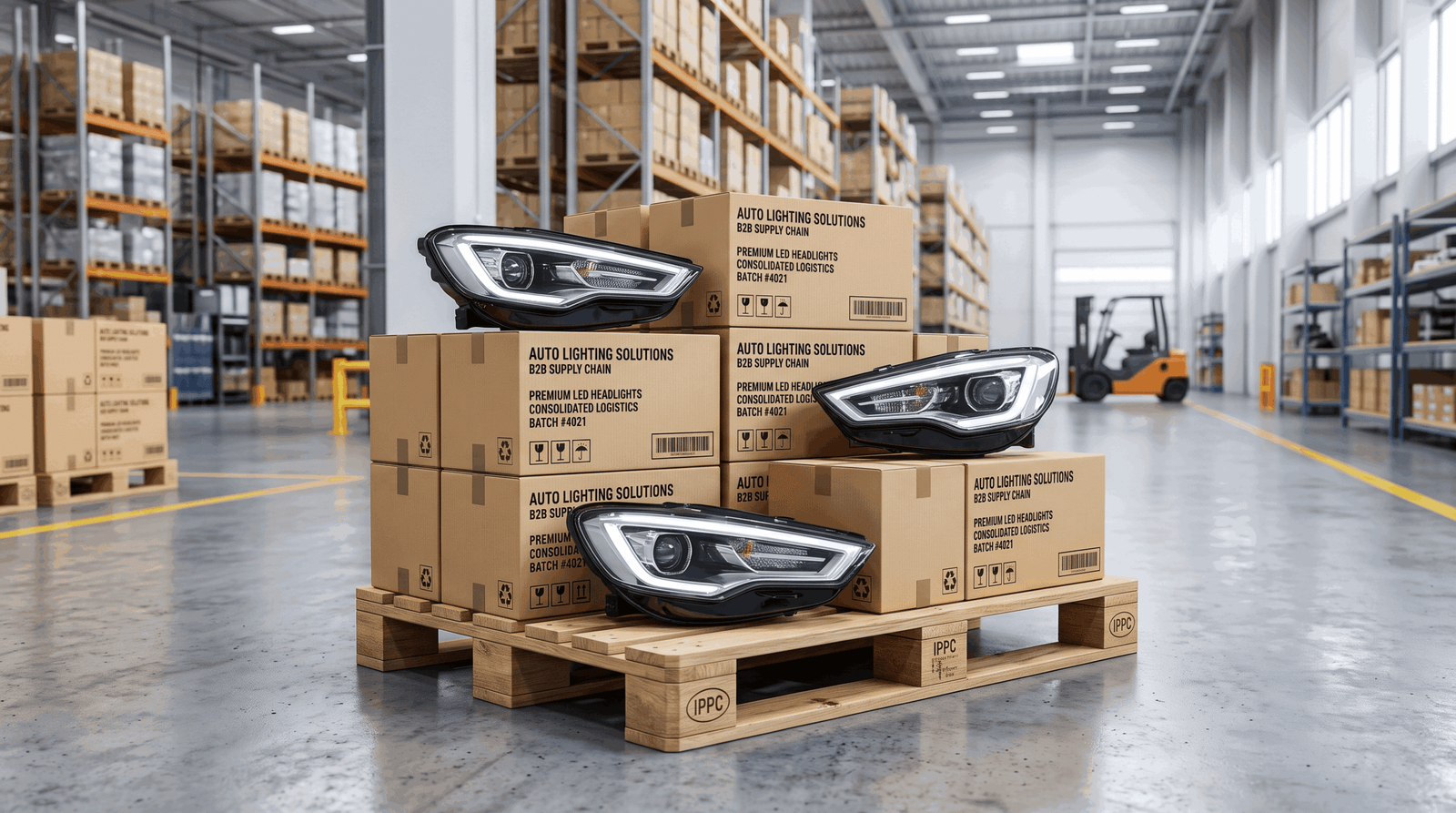
A one-stop sourcing partner can help solve this through mixed-container consolidation. Products from different factories can be collected at a designated warehouse or consolidation point and prepared for shipment together.
This approach can be particularly useful when a distributor is purchasing several automotive lighting SKUs but does not want each factory to arrange a separate shipment.
Freight Cost Savings: LCL vs. FCL Consolidation
| Shipping Metric | Multiple LCL Shipments | Consolidated FCL Shipment |
| Freight Rate | Generally higher cost per CBM for smaller shipments | Potentially more economical when container volume is sufficient |
| Cargo Handling | Goods may be handled through multiple logistics points | Cargo can be consolidated and loaded together |
| Documentation | Multiple shipment arrangements may be required | One coordinated shipment can simplify administration |
| Damage Risk | More handling can increase exposure to handling damage | Fewer logistics handoffs may reduce handling exposure |
| Delivery Planning | Different suppliers may have different schedules | Shipment can be coordinated around a consolidated dispatch date |
FCL does not automatically mean lower cost. The actual savings depend on shipment volume, destination, freight rates, product packaging, and other logistics factors.
However, when enough SKUs and volume are combined, a consolidated shipment can improve freight efficiency and simplify the distributor’s import process.
Instead of receiving separate shipments of LED kits, halogen bulbs, and other automotive lighting products from different factories, a sourcing partner can coordinate the products into a consolidated shipment and help optimize the overall logistics plan.
Flexible MOQ & Trial Orders
Direct manufacturers often set minimum order quantities based on production efficiency, material purchasing, product customization, and assembly requirements. Depending on the product and customization level, an MOQ of several hundred units per model may be required.
For a distributor testing a new market or adding a less common headlight model, committing to a large quantity can tie up working capital and increase the risk of slow-moving inventory.
A one-stop sourcing partner can sometimes provide more flexible MOQ options because it may have access to existing inventory, coordinate production across multiple customers, or maintain established relationships with several factories.
This makes MOQ negotiation more practical, particularly for standard products that do not require extensive customization.
- Market Testing: Start with a smaller quantity of a new LED model when available before committing to larger production volumes.
- Cash Flow Optimization: Align purchasing quantities with actual sales forecasts instead of overstocking every SKU.
- Niche Vehicle Coverage: Test lower-volume products for older or less common vehicle applications without immediately committing to a large production run.
- Product Expansion: Add new headlight models to your catalog without necessarily opening a separate supplier relationship for every SKU.
Actual MOQ depends on the product, factory requirements, customization, packaging, and order volume. A good sourcing partner should communicate these conditions clearly rather than promising an artificially low MOQ for every product.
Private Labeling & Brand Support
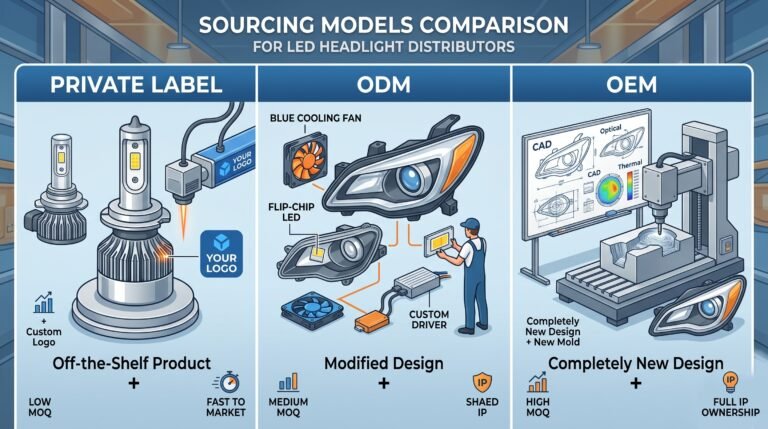
In a competitive automotive aftermarket, selling completely generic headlights can make it difficult for distributors to differentiate themselves. Building a private label can help create a more consistent product identity and strengthen long-term customer recognition.
A capable one-stop sourcing partner can provide end-to-end support for private label headlights. Because the sourcing partner coordinates products, packaging, and other supply-chain processes, distributors can work toward a more consistent brand presentation across products sourced from different production lines.
Private Label Services Offered
- Custom Packaging: Designing and producing customized packaging with your brand logo, product information, and market-specific requirements.
- Logo Marking: Depending on the product material and design, logos or part numbers can be applied through suitable methods such as laser marking or printing.
- Instruction Manuals: Preparing localized installation guides and product instructions for the target market.
- Product Documentation: Providing product specifications, images, packaging information, and other materials needed for distributor catalogs or websites.
- SKU and Label Coordination: Keeping product names, part numbers, labels, and packaging information consistent across the selected product range.
Private-label requirements should be confirmed before production because MOQ, tooling, packaging, artwork, and marking requirements can vary significantly between products.
How to Choose a Reliable Supplier
Not all automotive lighting suppliers and sourcing partners provide the same level of service. Transitioning from direct multi-factory purchasing to a consolidated sourcing model requires finding a partner that can manage products, quality, communication, and logistics reliably.
So, how to choose a supplier that can support your long-term business?
When conducting your supplier evaluation, look for these key indicators:
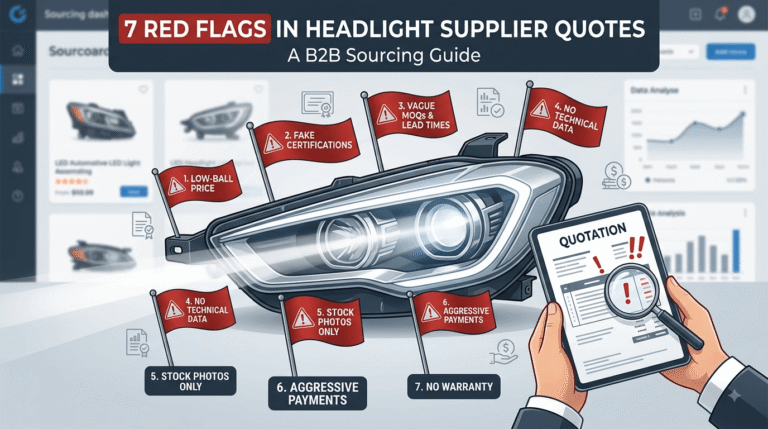
| Evaluation Criteria | What to Look For | Red Flags |
| Industry Expertise | Demonstrated experience with automotive lighting and aftermarket applications | Sells unrelated products with little automotive expertise |
| Transparency | Clear information about sourcing, production, QC procedures, and documentation | Avoids reasonable questions about suppliers or inspection processes |
| Product Capability | Broad SKU coverage and clear product specifications | Cannot provide consistent technical information |
| Quality Control | Defined inspection procedures and documented QC results | No clear inspection standards |
| MOQ Flexibility | Clearly explains MOQ differences between standard and customized products | Promises unrealistically low MOQs without explaining conditions |
| After-Sales Support | Clear warranty terms and defined defect-handling procedures | Stops responding once goods have shipped |
| Communication | Fast, consistent communication through a dedicated contact | Multiple departments provide conflicting information |
The goal is not simply to find the supplier offering the lowest unit price. The better question is whether the sourcing partner can deliver a competitive total landed cost while maintaining product quality, communication, and reliable fulfillment.
Frequently Asked Questions (FAQ)
One-stop headlight sourcing means purchasing multiple automotive lighting products through a single sourcing partner instead of independently managing multiple factories. Depending on the supplier's capabilities, the service may include product sourcing, QC, consolidation, private labeling, packaging, and logistics coordination.
Not necessarily. A factory may offer a lower unit price for a specific product, but direct purchasing can also involve additional costs related to separate shipments, supplier management, multiple transactions, high MOQs, quality inspections, and inventory.
A one-stop sourcing partner may help reduce these overall costs by coordinating multiple parts of the purchasing process. The right comparison is therefore the total landed cost, rather than unit price alone.
Yes, depending on the sourcing partner's product network and inventory. A one-stop automotive lighting sourcing partner may coordinate multiple products such as H1, H4, H7, H11, 9005, 9006, 9007, LED conversion kits, and other lighting products.
However, product availability, MOQ, customization, and production lead time should be confirmed for each SKU.
Many sourcing partners can support private-label programs, including customized packaging, logo marking, product labels, manuals, and marketing materials. The available options and minimum quantities depend on the product and factory.
When a distributor purchases through a one-stop sourcing partner, that partner can serve as the primary point of contact for coordinating factory communication, inspection records, warranty claims, and replacement arrangements.
However, the exact responsibility for defective products depends on the purchase agreement, warranty terms, inspection requirements, and contractual relationship between the buyer and sourcing partner. These terms should be clearly defined before placing an order.