How to Choose a Reliable Headlight Supplier in China: The Ultimate 8-Step Guide
Sourcing automotive headlights from China can be a highly lucrative strategy for your auto parts business. However, navigating the sea of suppliers on Alibaba, Made-in-China, or Global Sources can be overwhelming. A bad batch of LED headlights can lead to dangerous beam patterns, customer returns, and severe damage to your brand’s reputation.
How do you filter out the middlemen and find a top-tier manufacturing partner? In this comprehensive guide, we will walk you through a proven 8-step framework to choose a reliable headlight supplier in China.
Why Source Automotive Headlights from China?
China is the undisputed powerhouse of automotive lighting manufacturing. From aftermarket LED bulbs to complete OEM headlight assemblies, the Chinese supply chain offers unmatched scalability and cost-efficiency.
The Dongguan & Pearl River Delta Cluster
When sourcing headlights, location matters. Guangdong province—specifically the Dongguan and Guangzhou manufacturing cluster—is the heart of the automotive lighting industry. This region houses a complete supply chain ecosystem, from raw aluminum die-casting and PCB manufacturing to advanced LED chip packaging.
Global Automotive Lighting Supply Chain Data (2023-2024)
| Metric | China’s Market Share | Key Advantage |
| Aftermarket LED Headlights | ~85% | Rapid product iteration and vast mold availability. |
| Manufacturing Cost | 30%-40% Lower | Integrated local supply chains reduce raw material transport costs. |
| R&D Speed (New Models) | 15-30 Days | High concentration of optical engineers in the Dongguan region. |
| Production Lead Time | 2-4 Weeks | Automated SMT (Surface Mount Technology) lines ensure high output. |
Distinguish Between Two Types of Suppliers: Factory vs. Trading Company
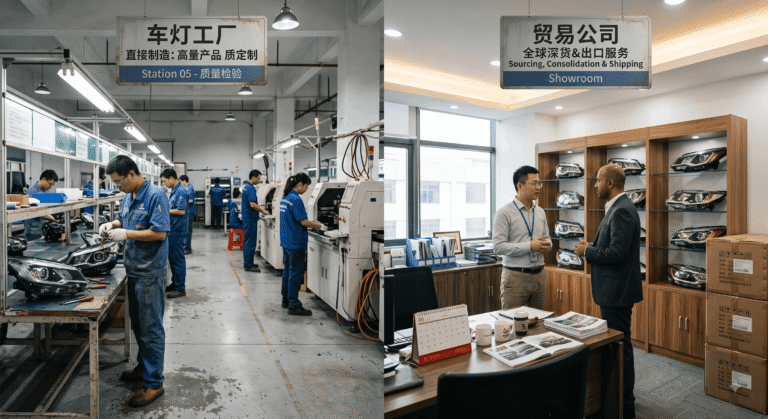
Before sending out a single RFQ, you must understand who you are talking to. The Chinese B2B landscape is divided into two main entities. To make the best procurement decision, you need to understand the nuances of a headlight factory vs trading company.
| Feature | Direct Manufacturer (Factory) | Trading Company (Middleman) |
| Pricing | Lowest (Direct factory price) | 10% – 30% markup |
| MOQ (Minimum Order) | Usually higher (e.g., 500+ sets) | Often lower (e.g., 50-100 sets) |
| Customization | Full OEM/ODM & Optical R&D | Limited to packaging/logos |
| Quality Control | Direct control over the production line | Dependent on the outsourced factory |
| Best For | Scaling brands, custom optical designs | Small retailers testing multiple product lines |
The 8-Step Framework to Choosing a Supplier
Follow these eight critical steps to evaluate, vet, and secure a reliable headlight manufacturing partner.
Step 1: Verify Certifications (IATF 16949 & Product Standards)
In the automotive industry, quality is a matter of life and death. Your supplier must have systemic quality control and region-specific product certifications.
Factory System Certification: Look for IATF 16949. This is the strict quality management standard specifically for the automotive industry. ISO 9001 is good, but IATF 16949 is the gold standard.
Product Certifications: Your target market dictates the required legal standards. Learn how to verify factory certifications online to ensure they comply with ECE, DOT and CCC requirements.
DOT (FMVSS 108): Required for the USA/North America.
ECE (E-Mark): Required for Europe and many other regions.
CCC: Required for the Chinese domestic market.
Step 2: Conduct a Thorough Factory Audit
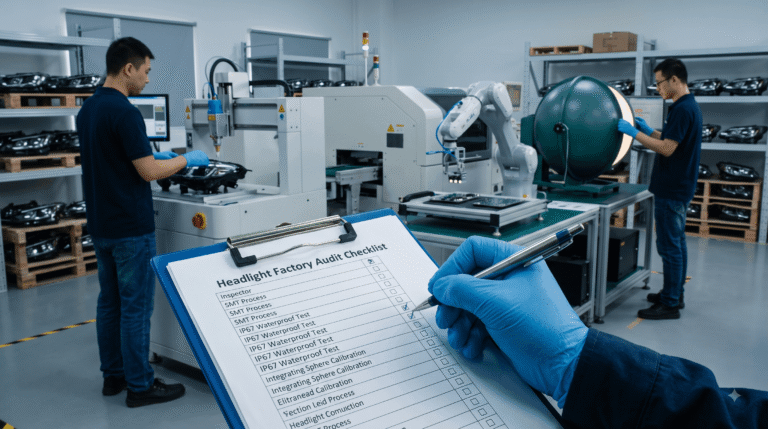
Never rely solely on glossy brochures. You need to inspect the real production environment. If you cannot fly to China, hire a local third-party agency or request a live video tour. Use our comprehensive partner factory audit checklist and focus on three key areas:
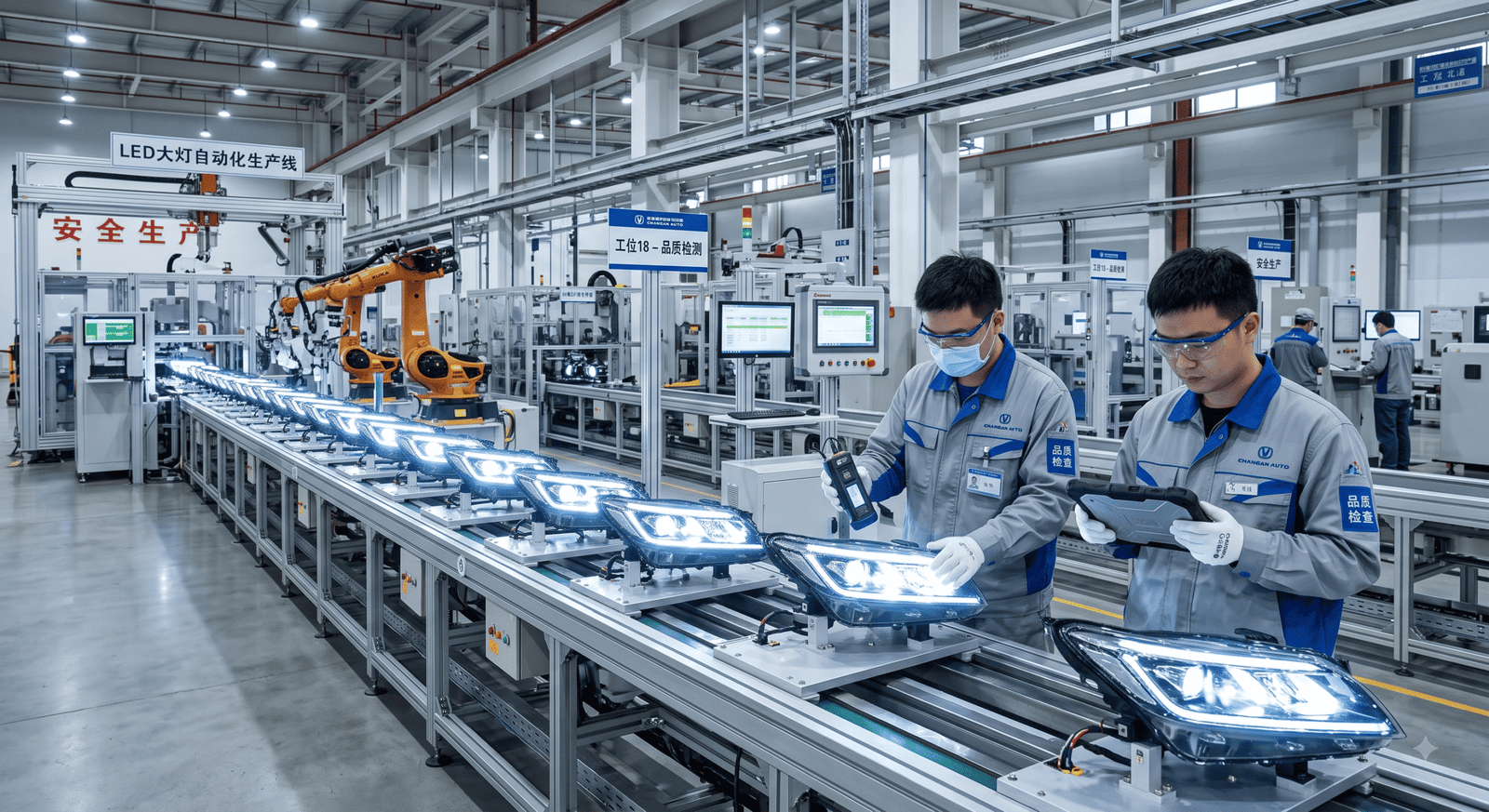
SMT Workshop: Are they mounting their own LED chips? Dust-free environments are crucial.
Optical Laboratory (Goniophotometer): Do they have a dark room to test the lux, lumens, and beam pattern accuracy?
Reliability Testing: Look for waterproof testing (IP67/IP68), salt spray testing, and high/low-temperature aging ovens.
Step 3: Sample First (The 48H Rule & 7.5m Wall Test)
A reliable factory should be able to prepare standard samples within 48 hours. Once you receive the sample, conduct the 7.5-meter wall test.
Shine the headlight on a flat wall from exactly 7.5 meters (25 feet) away.
A high-quality LED headlight will have a distinct cut-off line (especially for low beams) to avoid blinding oncoming traffic. Check for dark spots or scattered light.
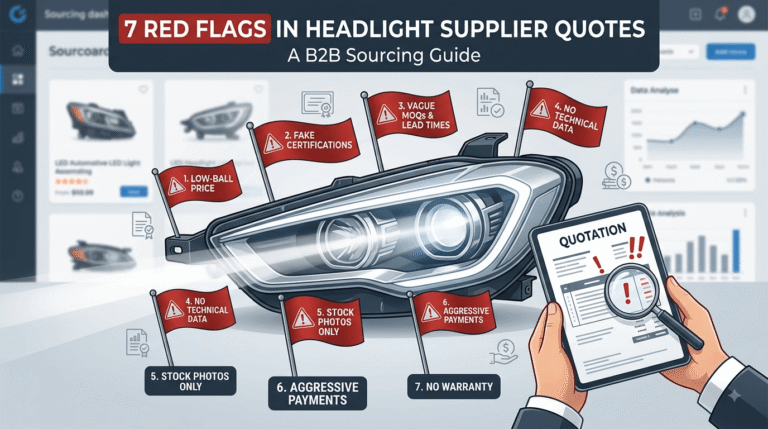
Step 4: Avoid the Traps (Quotation Red Flags)
Not all suppliers play fair. Be wary of quotes that are 40% cheaper than the market average. This usually means they are using inferior materials (e.g., cheap cooling fans, fake CREE/Philips chips, or poor heat-dissipating aluminum). Be sure you know how to identify these supplier red flags before transferring any money.
Step 5: Negotiate MOQ and Payment Terms
Once you are satisfied with the samples, it’s time to negotiate.
Standard Payment Terms: 30% TT deposit upfront, 70% TT before shipment (after inspection).
MOQ: Expect standard MOQs around 100-500 sets depending on the customization level.
Read our detailed guide on standard MOQ, sample and payment terms for auto parts sourcing.
Step 6: Choose Your Customization Model
How do you want to build your brand? Communicate your business model clearly to the factory:
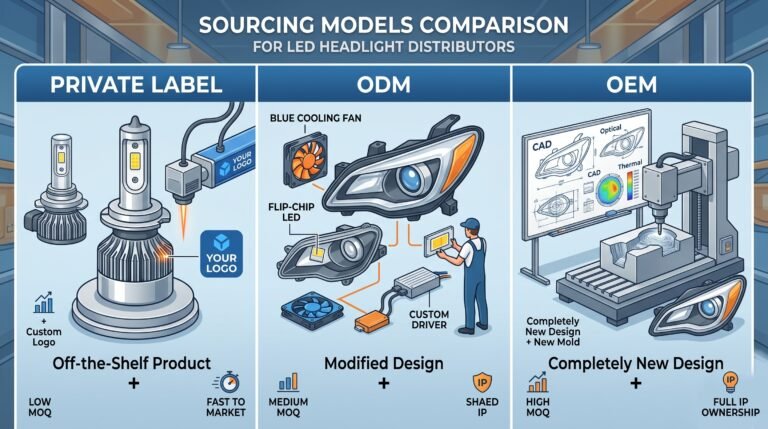
Private Label (White Label): Standard factory product, but with your logo laser-engraved on the bulb and custom color box packaging.
OEM (Original Equipment Manufacturer): Manufacturing a product exactly to your existing blueprints.
ODM (Original Design Manufacturer): The factory designs a completely new product (e.g., a new heatsink or custom LED array) specifically for you.
Learn more about which model fits your business: OEM vs ODM vs private label.
Step 7: Pre-Shipment Inspection (PSI) and Shipping
Never let the goods leave the factory without an inspection. Hire a third-party QC company (like SGS or V-Trust) to conduct a pre-shipment inspection based on AQL (Acceptable Quality Limit) standards (usually AQL 2.5 for major defects). They will check for cosmetic defects, functionality, and correct packaging.
Step 8: Solidify Contracts and After-Sales Support
A reliable supplier stands behind their product. Your Proforma Invoice (PI) or formal contract must clearly state the warranty terms.
A standard LED headlight warranty is 12 to 24 months.
Clearly define the replacement procedure: Will they send free replacements with the next batch, or require you to ship defective parts back to China? (The former is standard practice).
Supplier Evaluation Checklist: Metrics & Red Lines
Use this quick-reference table to grade your potential suppliers during your procurement process.
| Step | Evaluation Metric | Ideal Standard |  Red Line (Dealbreaker) Red Line (Dealbreaker) |
| 1. Certification | Quality & Market Compliance | IATF 16949, DOT/ECE valid certificates | Only holds expired or fake ISO9001 |
| 2. Factory Audit | Production & Testing Setup | In-house SMT, Dark room, Aging racks | No testing equipment visible on site |
| 3. Sampling | Beam Pattern & Heat | Perfect cut-off line, stable temp under 90°C | Glaring scattered light, fan noise |
| 4. Quotation | Price Transparency | Itemized BOM (Bill of Materials) quote | Vague quotes significantly below market |
| 5. Terms | Financial Safety | 30/70 TT, Low sample MOQ | Demands 100% upfront via Western Union |
| 6. Customization | R&D Capability | Has in-house optical & structural engineers | Only offers 1-2 generic outdated models |
| 7. Inspection | Transparency | Welcomes 3rd-party AQL inspections | Refuses independent QC before shipping |
| 8. Warranty | After-sales Support | 1-2 Years, replacements with next order | “No returns once shipped” policy |