
Headlight Sourcing Guide: MOQ, Samples, and Payment Terms Every Distributor Should Negotiate
As an automotive lighting distributor, securing a profitable partnership with a headlight supplier goes far beyond negotiating the lowest unit price. The real challenge in protecting your cash flow and building a scalable supply chain lies in the finer details of the purchasing agreement: Minimum Order Quantities (MOQ), Sample Policies, Payment Terms, and overall purchasing conditions.
Whether you are importing LED conversion kits, sealed beam headlights, headlamp assemblies, or OEM replacement products, understanding these procurement factors can make the difference between a flexible supply chain and costly inventory problems. In this guide, we break down common industry practices, negotiation strategies, and total-cost considerations to help distributors make better purchasing decisions.
1. Demystifying Headlight Sourcing and MOQ Structures
MOQ is one of the first issues distributors encounter during headlight sourcing. Manufacturers use Minimum Order Quantity requirements to maintain production efficiency and control setup costs. For distributors, however, excessive MOQ requirements can tie up working capital in inventory that may take months to sell.
In headlight sourcing, there is no universal MOQ that applies to every automotive lighting product. MOQ depends on the product type, whether the item is stocked or made to order, the level of customization, packaging requirements, tooling requirements, and the supplier’s production process.
Standard Headlight Sourcing MOQ Ranges
| Order Type | Common MOQ Range | Description & Buyer Persona |
|---|---|---|
| Standard SKU (In-Stock) | 10–100+ pcs / SKU | Suitable for new distributors testing demand. Stock availability can significantly reduce the required MOQ. |
| Mixed Batch Orders | Supplier-dependent | Multiple SKUs may be combined to reach a total order quantity. Particularly useful for wholesalers building a broader catalog. |
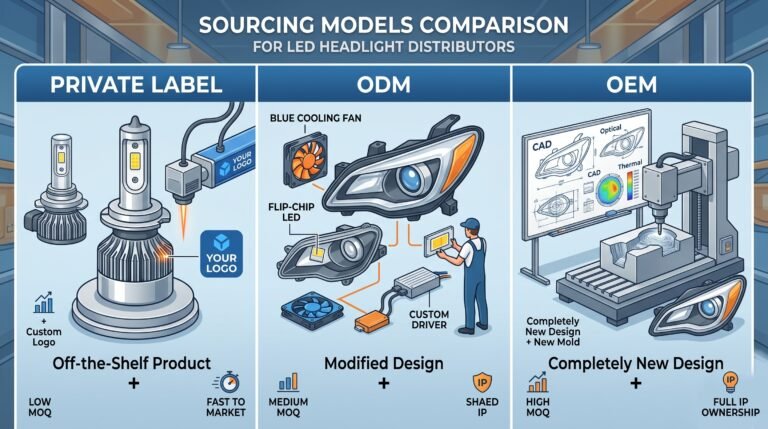
| White-Label (Custom Packaging) | 100s–1,000+ pcs | MOQ depends largely on packaging requirements, printing method, and whether dedicated packaging materials must be produced. |
| OEM/ODM (Custom Product) | 1,000+ pcs in many cases | Custom optics, housings, heat sinks, electronics, tooling, or other product modifications normally require substantially higher volumes. |
These figures should be treated as reference ranges rather than fixed industry standards. In headlight sourcing, a supplier with existing inventory may accept a much smaller order, while a highly customized product may require a substantially larger commitment.
Factory vs. Trading Company: Why MOQ Can Be Different
Before negotiating MOQ, distributors should identify what type of supplier they are dealing with.
| Supplier Type | Typical MOQ | Price Level | Customization |
| Manufacturer / Factory | Medium to High | Usually Lower | Higher |
| Trading Company | Often Lower | Usually Higher | Depends on factory network |
| Stock Distributor / Wholesaler | Often Lowest | Usually Higher | Limited |
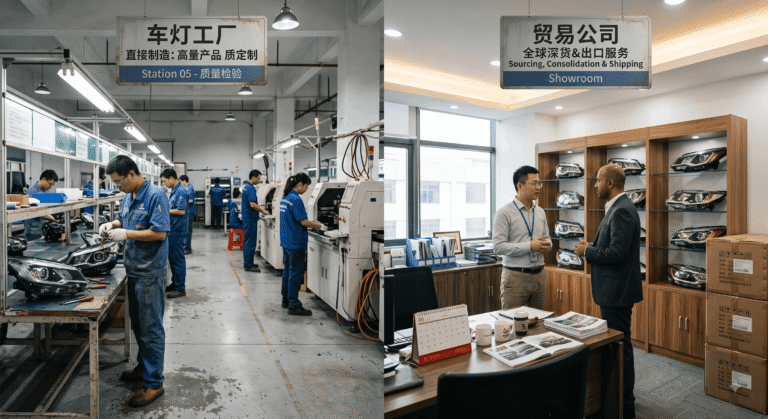
Trading companies can sometimes offer lower MOQs because they consolidate demand from multiple customers or hold inventory. The trade-off may be a higher unit price or less direct control over customization and production.
Pro Tip: Instead of simply asking, “What is your MOQ?”, ask:
“What is your MOQ for an existing SKU, and what would the MOQ be if we combine several SKUs into one order?”
This gives you a much better basis for comparing suppliers.
If a supplier quotes a high MOQ for a standard product, ask whether the requirement is caused by production setup, packaging, inventory availability, or simply the supplier’s commercial policy.
2. Sample Policies and Lead Times
Never place a significant bulk order without evaluating samples first. Automotive lighting products should be assessed for factors such as lumen output, beam pattern, cutoff performance, CANbus compatibility, heat dissipation, fitment, electrical compatibility, and overall build quality.
Sample Lead Time and Cost Allocation
| Sample Category | Indicative Lead Time | Cost Allocation | Shipping Fee |
| Off-the-Shelf (Standard) | Often 1–3 business days | Sample may be charged and may be refundable against a qualifying bulk order | Usually paid by Buyer |
| Semi-Custom (Logo / Packaging) | Often 5–7+ days | Buyer may pay sample and customization costs | Usually paid by Buyer |
| Full OEM Customization | Often 15–30+ days | Higher sample / development costs may apply | Usually paid by Buyer |
Actual lead times depend on product availability, engineering requirements, tooling, and the supplier’s production schedule.
How to Negotiate Sample Costs
A common negotiation approach is to request that the sample fee be credited against a future bulk order.
Instead of simply asking for a “free sample”, use a clearer commercial condition:
“If we place a qualifying bulk order, can the sample cost be credited against the first official PO?”
The important point is to define the condition in advance.
For example:
- Minimum qualifying order quantity
- Validity period
- Whether freight is refundable
- Whether customization/tooling costs are refundable
This prevents misunderstandings after the sample has been approved.
3. Standard Payment Terms in the Automotive Lighting Industry
Payment terms directly affect both cash flow and supplier risk. A 100% advance payment gives the supplier maximum security but leaves the buyer with limited leverage if production or quality problems occur.
Distributors should therefore negotiate payment terms according to the supplier relationship, order value, credit history, and level of trust.
Comparison of Global Trade Payment Terms
| Payment Term | Typical Structure | Buyer Risk | Cash Flow Impact | Best Used For |
| T/T (Telegraphic Transfer) | 30% Deposit / 70% Before Shipment | Medium | Moderate | Common for standard B2B orders, particularly with established suppliers |
| L/C (Letter of Credit) | Irrevocable / At Sight or Usance | Low to Medium* | Higher Banking Cost | Larger transactions where documentary control is important |
| D/P (Documents against Payment) | Buyer pays before receiving the shipping documents | Relatively Low | Moderate | Established trading relationships where documentary collection is acceptable |
| NET 30 / O/A (Open Account) | Payment 30 days after agreed invoice/delivery terms | Lowest for Buyer | Excellent | Established buyers with strong supplier relationships and appropriate credit arrangements |
*The actual risk under an L/C depends on the terms, document requirements, issuing/confirming banks, and compliance with the credit.
Understanding D/P Correctly
With D/P (Documents against Payment), the supplier ships the goods and the shipping documents are handled through the banking system. The buyer generally needs to make payment before the documents are released.
Therefore, D/P should not be described simply as “the factory ships before getting paid.” The supplier has shipped the goods, but the buyer does not normally receive the documents needed to take control of the shipment until payment is made under the agreed collection process.
Moving Toward Better Payment Terms
For an established distributor, the long-term objective should not necessarily be “NET 30 at all costs.”
A more practical progression may be:
100% T/T → 30/70 T/T → smaller deposit / balance after inspection → partial credit → NET 30 or other open-account terms
The appropriate target depends on the supplier relationship, order volume, financial strength, and whether credit insurance or other risk controls are available.
4. Calculating the Total Cost Beyond Unit Price
Amateur buyers often compare only the EXW unit price. Professional distributors calculate the Landed Cost.
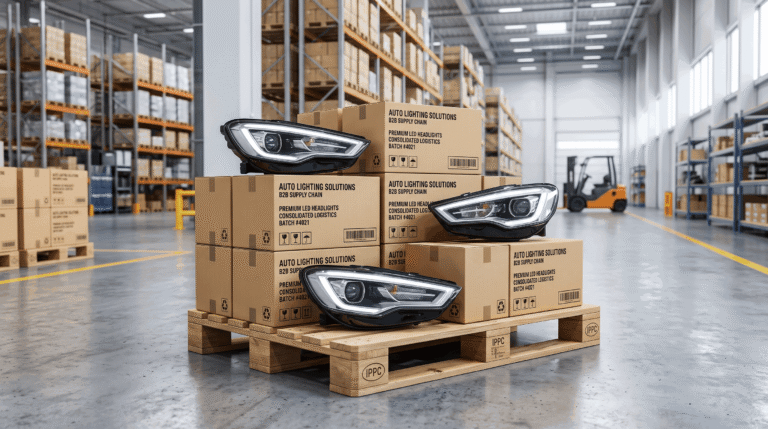
A headlight quoted at $15 EXW does not necessarily cost $15 when it reaches your warehouse. Depending on the destination market, shipment size, freight method, taxes, duties, and local logistics costs, the final landed cost can be substantially higher.
The Hidden Costs of Importation
| Cost Component | Typical Impact | Description |
| Product Unit Price | Base Price | Cost of the product itself under the agreed Incoterm. |
| Inland Freight | Variable | Transportation from the supplier’s facility to the export point or consolidation warehouse. |
| Sea / Air Freight | Highly Variable | Depends on shipment volume, weight, destination, season, and freight method. |
| Customs & Tariffs | Country-specific | Depends on HS classification, country of origin, destination regulations, and applicable trade measures. |
| Insurance & Port / Handling Fees | Variable | May include cargo insurance, terminal handling, customs brokerage, documentation, and other destination charges. |
The exact impact should always be calculated for the specific destination market rather than applying a universal percentage.
For example:
Landed Cost = Product Cost + Inland Logistics + International Freight + Insurance + Duties/Taxes + Customs/Brokerage + Destination Charges
This calculation gives distributors a much more realistic basis for comparing suppliers.
To protect your margins, map out every major cost before negotiating the supplier’s unit price. Use our Landed Cost Calculator to forecast your true purchasing cost based on your shipment details.
5. Choosing the Right Incoterms
Your landed cost and level of logistics control are directly affected by the Incoterm you negotiate.
Incoterms define key responsibilities between the buyer and seller, including transportation arrangements, costs, and the point at which risk transfers. They do not, by themselves, determine every aspect of ownership, payment, customs compliance, or product liability.
Common Incoterms for Headlight Distributors
| Incoterm | Who Arranges Main Freight? | Who Handles Import Clearance / Duties? | Buyer Control | Recommended For |
| EXW (Ex Works) | Buyer | Buyer | Maximum | Buyers with strong logistics capabilities or local sourcing teams |
| FOB (Free on Board) | Buyer arranges main carriage | Buyer | High | Buyers who want control over international freight |
| CIF (Cost, Insurance and Freight) | Seller arranges main carriage | Buyer | Medium | Buyers who prefer the supplier to arrange ocean freight |
| DDP (Delivered Duty Paid) | Seller | Seller, subject to the applicable customs structure | Lower | Smaller or less experienced buyers prioritizing convenience |
Important Incoterm Considerations
EXW can provide significant control, but it may not always be the most practical option for international buyers purchasing from overseas factories.
FOB is commonly used for sea freight because the buyer controls the main international transportation after the agreed FOB point.
CIF can simplify ocean freight arrangements, but buyers should compare the supplier’s freight quotation against independent freight rates.
DDP offers the greatest convenience, but buyers should confirm exactly who is acting as the importer of record, who handles customs clearance, and how duties and taxes are calculated in the destination country.
Not sure which option fits your order volume and logistics capability? Read our deep dive on FOB vs CIF vs DDP before making a decision.
6. Proven Negotiation Scripts for Distributors
Negotiating with manufacturers requires more than simply asking for a lower price. The strongest negotiations usually exchange volume, forecast visibility, payment reliability, or long-term commitment for better commercial terms.
Here are three practical scripts distributors can use.
1. Negotiating the Trial Order
“We are a fast-growing distributor in [Your Country] looking to develop a long-term supplier relationship. Our standard annual demand is expected to exceed 2,000 units, but our company policy requires a market-test order of 100 units per SKU before vendor approval. If the trial performs well, can you support this initial order at a more competitive volume price?”
This approach is more realistic than simply asking the supplier to ignore its MOQ. You are giving the supplier a reason to accept a smaller initial order: future volume potential.
2. Structuring Tiered Pricing
“Your EXW price of $18/set is slightly above our target. If we commit to an annual purchasing plan, can we structure a tiered pricing model? For example, $18 for the first 1,000 units, with the price reviewed or reduced once our cumulative annual volume reaches 5,000 units.”
This is more flexible than demanding an immediate price reduction. It also gives the supplier a clear commercial incentive.
3. Securing Regional Protection
“We have the marketing budget to develop your brand in [Your Region]. However, we need reasonable channel protection before making significant investments. If we commit to an annual purchase target of 10,000 units, would you consider a 12-month regional distribution agreement with clearly defined territory, performance requirements, and exceptions?”
Regional exclusivity should never be treated as an automatic right simply because a distributor reaches a certain MOQ.
A proper agreement should clarify:
- Territory
- Product scope
- Annual purchase target
- Existing customers and channel exceptions
- Online sales restrictions
- Duration
- Conditions for renewal
- Conditions for termination
This protects both the supplier and distributor while making the commercial commitment measurable.
Mastering these conversations is critical to building long-term supplier relationships. For more advanced strategies, continue reading our guide on Long-Term Supplier Management.
Frequently Asked Questions (FAQ)
Often, but not always.
Trading companies may consolidate orders from multiple buyers or maintain inventory, allowing them to offer lower MOQs than a factory producing specifically for one customer.
The trade-off may be a higher unit price and potentially less flexibility for custom OEM modifications.
For standard stock products, however, a trading company can sometimes be the more practical option for a distributor that wants to test a market before committing to factory-level volumes.
Usually not.
Some suppliers may provide a sample at no product charge, but the buyer will often still be responsible for international express shipping.
For paid samples, a common negotiation is to request that the sample cost be credited against the first qualifying bulk order.
Before agreeing, confirm whether the credit includes:
- Product sample cost
- Customization cost
- Tooling cost
- Freight
- Minimum qualifying order quantity